Weak homotopy equivalences are the absolute shadow of covariant and contravariant equivalences. Over the terminal category, left and right fibrations are both precisely animae, so the two notions agree and are detected by geometric realization. The main result of this section is a relative form of Quillen’s theorem A: a functor over \(S\) is a covariant equivalence precisely when it is a weak homotopy equivalence on every relative slice.
Definition 9.5.1. A functor \(f\colon C \to B\) is called a weak homotopy equivalence if it is a covariant equivalence over \(*\). A category \(C\) is called weakly contractible if the functor \(p_C\colon C \to *\) is a weak homotopy equivalence.
Lemma 9.5.2. For a functor \(f\colon C \to B\), the following are equivalent:
(1) The functor \(f\) is a weak homotopy equivalence.
(2) For every anima \(X\), the induced map \[ \Map(B,X) \to \Map(C,X) \] is an equivalence.
(3) The induced map \(\Pi_{\infty}(f)\colon \Pi_{\infty}(C) \to \Pi_{\infty}(B)\) is an equivalence.
Proof
The equivalence between (1) and (2) is immediate, since by Proposition 4.2.4 a functor \(X \to *\) is a left fibration if and only if \(X\) is an anima. By Lemma 3.4.3, condition (2) is equivalent to requiring that \(f\) induce an equivalence \[ \Map(\Pi_{\infty}(B), X) \iso \Map(\Pi_{\infty}(C), X) \] for every anima \(X\). This is equivalent to (3) by Proposition 1.4.11.
Corollary 9.5.3. A category \(C\) is weakly contractible if and only if its geometric realization \(\Pi_{\infty}(C)\) is contractible.
Example 9.5.4. Any initial (or terminal) functor is a weak homotopy equivalence.
The comparison between fibers and relative slices is where the proper and smooth functors from the preceding section enter. Smoothness preserves the initial map into a left-fibration replacement, while properness identifies the fiber with the corresponding slice up to weak homotopy equivalence.
Lemma 9.5.5. Consider a commutative triangle of the form
 where \(i\) is initial and where \(p\) is a left fibration. Then, for any object \(s\) of \(S\), the following two functors are weak homotopy equivalences:
\[
A_{/s} \to X_{/s} \leftarrow X_s.
\]
In fact, \(A_{/s} \to X_{/s}\) is initial and \(X_s \to X_{/s}\) is terminal.
Proof
Consider the following pullback diagram:
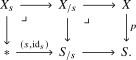 Since \(p\) is a left fibration, it is proper, so the terminal functor \(* \to S_{/s}\) pulls back to a terminal functor \(X_s \to X_{/s}\). Consider now the following commutative diagram:
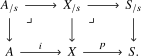 Since the functor \(S_{/s} \to S\) is a right fibration, it is in particular smooth, so the initial functor \(i\colon A \to X\) pulls back to an initial functor \(A_{/s} \to X_{/s}\).
Proposition 9.5.6 (Relative Quillen theorem A). Consider a commutative triangle
 Then \(f\) is a covariant equivalence over \(S\) if and only if for every object \(x\) of \(S\) the induced map
\[
C_{/x} \to D_{/x}
\]
is a weak homotopy equivalence.
Proof
The first step is to construct a commutative diagram of the form
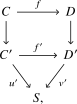 where the two vertical maps are initial and the two diagonal maps \(u'\) and \(v'\) are left fibrations. The vertical maps are covariant equivalences over \(S\), so 2-out-of-3 shows that \(f\) is a covariant equivalence if and only if \(f'\) is. Since \(u'\) and \(v'\) are left fibrations, Lemma 9.1.6 identifies the latter condition with \(f'\) being an equivalence. By Lemma 6.1.12, this is equivalent to requiring that \(C'_x \to D'_x\) be an equivalence for every \(x\).
Finally, Lemma 9.5.5 gives weak homotopy equivalences \[ C_{/x}\to C'_{/x}\leftarrow C'_x \qquad\text{and}\qquad D_{/x}\to D'_{/x}\leftarrow D'_x. \] Thus \(C_{/x}\to D_{/x}\) is a weak homotopy equivalence if and only if \(C'_x\to D'_x\) is a weak homotopy equivalence. Since \(C'_x\) and \(D'_x\) are animae, the latter is equivalent to \(C'_x\to D'_x\) being an equivalence. This proves the claim.
Corollary 9.5.7. A functor \(u\colon C \to D\) is initial if and only if, for every object \(d\) of \(D\), the relative slice \(C_{/d}\) is weakly contractible. Dually, \(u\) is terminal if and only if every relative coslice \(C_{d/}\) is weakly contractible.
Proof
The functor \(u\) is initial if and only if the diagram
 is a covariant equivalence. The statement now follows as the relative slice of the identity functor \(\id_D\) at any
object of \(D\) has a terminal object and is thus weakly contractible.
Corollary 9.5.8 (Quillen’s theorem A). Let \(f\colon C \to D\) be a functor such that the relative slice \(C_{/d}\) is weakly contractible for any object \(d\) of \(D\). Then \(f\) is a weak homotopy equivalence.
Proof
The preceding corollary shows that \(f\) is initial, and every initial functor is a weak homotopy equivalence by Example 9.5.4.