Proposition 9.5.6 (Relative Quillen theorem A). Consider a commutative triangle
 Then \(f\) is a covariant equivalence over \(S\) if and only if for every object \(x\) of \(S\) the induced map
\[
C_{/x} \to D_{/x}
\]
is a weak homotopy equivalence.
Proof
The first step is to construct a commutative diagram of the form
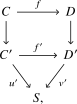 where the two vertical maps are initial and the two diagonal maps \(u'\) and \(v'\) are left fibrations. The vertical maps are covariant equivalences over \(S\), so 2-out-of-3 shows that \(f\) is a covariant equivalence if and only if \(f'\) is. Since \(u'\) and \(v'\) are left fibrations, Lemma 9.1.6 identifies the latter condition with \(f'\) being an equivalence. By Lemma 6.1.12, this is equivalent to requiring that \(C'_x \to D'_x\) be an equivalence for every \(x\).
Finally, Lemma 9.5.5 gives weak homotopy equivalences \[ C_{/x}\to C'_{/x}\leftarrow C'_x \qquad\text{and}\qquad D_{/x}\to D'_{/x}\leftarrow D'_x. \] Thus \(C_{/x}\to D_{/x}\) is a weak homotopy equivalence if and only if \(C'_x\to D'_x\) is a weak homotopy equivalence. Since \(C'_x\) and \(D'_x\) are animae, the latter is equivalent to \(C'_x\to D'_x\) being an equivalence. This proves the claim.
From Section 9.5, Weak homotopy equivalences and Quillen’s theorem A.