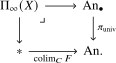
The cofinality factorization immediately implies that \(\An\) admits all small colimits. More generally, it constructs left Kan extensions of anima-valued functors. Given a functor \(F\colon C\to\An\) and a functor \(u\colon C\to D\), we unstraighten \(F\) to a left fibration over \(C\), factor its total category over \(D\) into an initial functor followed by a left fibration, and straighten the latter. Initiality gives the required universal property. Taking \(D=*\) then identifies the colimit of \(F\) with the geometric realization of the total category of its left fibration.
Theorem 9.3.1 (Anima-valued left Kan extensions). Let \(u\colon C \to D\) be a functor which has small fibers.
(1) Then the pullback functor \[ u^*\colon \Fun(D,\An) \to \Fun(C,\An) \] admits a left adjoint \(u_!\colon \Fun(C,\An) \to \Fun(D,\An)\).
(2) This left adjoint is given on objects as follows: for a functor \(F\colon C \to \An\), consider the pullback
 and apply Corollary 9.2.3 to factor the composite \(u \circ p\colon E \to D\) as a composite
\[
E \xrightarrow{j} Y \xrightarrow{q} D,
\]
where \(j\) is initial and \(q\) is a left fibration. Since \(u\) has small fibers, also \(q\) has small fibers, and thus there is a pullback square of the form
 Under directed univalence, the functor \((p,j)\colon E \to C \times_D Y\) over \(C\) corresponds to a natural transformation \(\eta_F\colon F \to u^*u_!(F)\). This is the unit component exhibiting \(u_!(F)\) as the value of the left adjoint at \(F\).
Proof
Consider a functor \(G\colon D \to \An\). We have to show that the canonical map
\[
\Hom_{\Fun(D,\An)}(u_!(F), G) \to \Hom_{\Fun(C,\An)}(F,u^*(G))
\]
is an equivalence. Define the left fibration \(r\colon Z \to D\) via the following pullback square:
 Directed univalence identifies the displayed map with
\[
\Map_D(Y,Z) \to \Map_C(E,C \times_D Z) \simeq \Map_D(E,Z)
\]
induced by precomposition with \(j\colon E \to Y\). Here we use Theorem 8.3.15 and Lemma 8.3.13. Since \(j\) is initial and \(r\colon Z \to D\) is a left fibration, this map is an equivalence.
Corollary 9.3.2. The category \(\An\) admits all small colimits.
Proof
For a small category \(C\), apply Theorem 9.3.1 to the functor \(p_C\colon C\to *\).
Suppose that \(C\) admits a terminal object \(\omega\). Then \(p_C\colon C\to *\) is left adjoint to \(\omega\colon *\to C\), so Proposition 4.4.4 gives an adjunction \[ \ev_{\omega}\colon \Fun(C,\An) \rightleftarrows \An \noloc p_C^*. \] Thus evaluation at a terminal object is left adjoint to the constant-diagram functor.
Notation 9.3.3. For a small category \(C\) with \(p_C\colon C \to *\), we write \[ \colim_C := (p_C)_!\colon \Fun(C,\An) \to \An. \] Sometimes this is also denoted by \(\varinjlim\).
Remark 9.3.4. Consider a pullback square
 The colimit \(\colim_C F\) is the geometric realization \(\Pi_{\infty}(X)\) of the total
category of the left fibration classified by \(F\). Indeed, it is obtained by factoring
\(X\to *\) into the initial functor \(X\to\Pi_{\infty}(X)\) followed by the left fibration
\(\Pi_{\infty}(X)\to *\). Equivalently, there is a pullback square