Corollary 12.2.12. Consider the pushout square of categories below.
 If \(f\) is fully faithful, so is \(g\).
Proof
We may assume that this is a commutative square of small categories (up to a choice of suitable
universe). Let us assume that \(f\) is fully faithful.
By virtue of Proposition 12.2.11
the functor
\[
f_!\colon\Fun(A,\An)\to\Fun(B,\An)
\]
is fully faithful. In other words, if we consider the induced pullback square
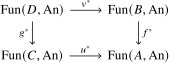 the functor \(f_!\) is a left adjoint section of \(f^*\).
Proposition 4.4.15 thus tells us that the functor
\(g^*\) has a left adjoint section, i.e. the functor \(g_!\) is fully faithful.
Another application of Proposition 12.2.11
implies that the functor \(g\) itself is fully faithful.