Definition 10.2.7 (Recursive sections). Let \(p\colon P\to\N\) be a functor and let \(f\colon P\to P\) be an endofunctor over the successor function. For a functor \(u\colon\N\to\N\), define the category \[ \operatorname{Sect}_u(p) \coloneqq \Fun(\N,P)\times_{\Fun(\N,\N)}\{u\}, \] where the functor from \(\Fun(\N,P)\) is postcomposition with \(p\). Thus \(\operatorname{Sect}_{\id_{\N}}(p)\) is the category of sections of \(p\), while \(\operatorname{Sect}_{\succ}(p)\) is the category of functors \(g\colon\N\to P\) over \(\succ\).
The category \(\operatorname{Rec}(p,f)\) of recursive sections is
defined by the pullback square
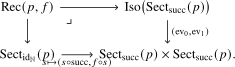 An object is a section \(s\colon\N\to P\) of \(p\)
together with an identification
\[
\vartheta\colon s\circ\succ\iso f\circ s
\]
over \(\N\). A morphism \((s,\vartheta)\to(t,\psi)\) is a natural
transformation \(\alpha\colon s\to t\) over \(\N\) equipped with a commutative square
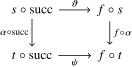 in \(\operatorname{Sect}_{\succ}(p)\).
Evaluation at zero gives a functor
\(\ev_0\colon\operatorname{Rec}(p,f)\to P_0\).