Definition 1.9.2. Let \(S\) be a category and let \(p\colon C \to S\) and \(q\colon D \to S\) be categories over \(S\).
We define the category \(\Fun_S(C,D)\) of relative functors over \(S\) as the following pullback:
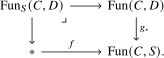 The objects of \(\Fun_S(C,D)\) are precisely the relative functors from \(C\) to \(D\) over \(S\).
We write \(\Map_S(C,D)\) for the groupoid core of \(\Fun_S(C,D)\), which fits into a pullback square of the form
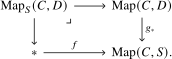 We may sometimes also write \(\Map_{/S}(C,D)\) for this anima.
A natural transformation over \(S\) is a morphism in \(\Fun_S(C,D)\). Given two relative functors \(f,g\colon C\to D\), with structural identifications \(\alpha:qf=p\) and \(\beta:qg=p\), such a relative natural transformation consists of a natural transformation \(\eta\colon f\to g\) together with the identification \[ \beta\circ(q\eta)=\alpha. \] Similarly, identifications over \(S\) are identifications in the anima \(\Map_S(C,D)\).