Proposition 8.2.6. Consider a cocartesian fibration \(p\colon W \to [2] \times S\). For \(0 \leq i < j \leq 2\), define the cocartesian fibration \(p_{ij}\colon W_{ij} \to [1]_{ij} \times S\) via the following pullback square:
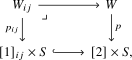 where \([1]_{ij}\) is the subcategory of \([2]\) spanned by \(i\) and \(j\). Then there is an identification
\[
\St(p_{02}) = \St(p_{12}) \circ \St(p_{01})
\]
of cocartesian functors \(W_0 \to W_2\) over \(S\).
Proof
The proof has two steps. We first extend the three transport constructions from the edges of \([2]\) to cocartesian functors over \([2]\times S\). We then compare the extension associated to \(0\to 2\) with the composite of the extensions associated to \(0\to 1\) and \(1\to 2\).
Via Construction 8.2.1, we obtain cocartesian functors
 and
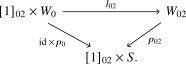 Restricting these three functors to \(\{j\} \times S \hookrightarrow [1]_{ij} \times S\) produces the three functors \(\St(p_{01})\), \(\St(p_{12})\) and \(\St(p_{02})\). We claim that these three diagrams can all be extended to cocartesian functors over \([2] \times S\) of the form
 and
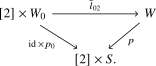 The map \(\overline{l}_{01}\) is obtained from \(l_{01}\) by pulling back along the map \(s_1\colon [2] \to [1]\) (given by \(0 \mapsto 0\), \(1 \mapsto 1\) and \(2 \mapsto 1\)). To obtain the map \(\overline{l}_{12}\), we write \([2]\) as a pushout of the span \([1]_{01} \leftarrow \{1\} \to [1]_{12}\), giving a pushout square
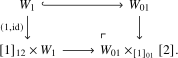 The map \(\overline{l}_{12}\) is then given on \(W_{01}\) by the inclusion \(W_{01} \hookrightarrow W\) and on \([1]_{12} \times W_1\) by the composite
\[
[1]_{12} \times W_1 \xrightarrow{l_{12}} W_{12} \hookrightarrow W;
\]
this is well-defined since the restriction of both functors to \(W_1\) is the inclusion \(W_1 \hookrightarrow W\). Since both \(l_{12}\) and the inclusion preserve cocartesian morphisms, it follows that \(\overline{l}_{12}\) preserves cocartesian morphisms lying over either \([1]_{01}\) or \([1]_{12}\), from which it follows that \(\overline{l}_{12}\) is indeed a cocartesian functor over \([2] \times S\).
It remains to extend the transport associated to \(0\to 2\). The map \(\overline{l}_{02}\) is
defined by finding a lift in the following commutative diagram:
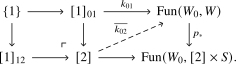 Since the left square is a pushout square, it suffices to construct a diagonal map \([1] \to \Fun(W_0, W)\) making the top and bottom triangle commute, but such a map exists uniquely due to the fact that \(p_*\) is a cocartesian fibration. Observe that the pullback of the map \(\overline{l}_{02}\) along the inclusion \([1]_{02} \times S \hookrightarrow [2] \times S\) is indeed the map \(l_{02}\): the restriction of its curried functor \(\overline{k_{02}}\) to \([1]_{02} \hookrightarrow [2]\) is a solution of the lifting problem
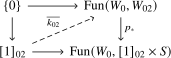 and must hence agree with the (unique) solution \(k_{02}\).
To finish the proof, observe that the composite \(\overline{l}_{12} \circ \overline{l}_{01}\colon [2] \times W_0 \to W\) is another cocartesian functor over \([2] \times S\) that satisfies the same lifting criterion as \(\overline{l}_{02}\). By uniqueness, we thus obtain an identification \[ \overline{l}_{02} = \overline{l}_{12} \circ \overline{l}_{01}. \] Pulling back along the inclusion \(\{2\} \times S \hookrightarrow [2] \times S\) then provides the desired identification \[ \St(p_{02}) = \St(p_{12}) \circ \St(p_{01}). \]