Proposition 5.4.1 (Substitution and pullback). For a category \(C\) in context \(A\), there is a pullback square
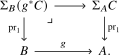 This square is natural in functors \(C\to D\) in context \(A\). For an object \(t\) of \(C\) in that context, the section corresponding to \(g^*t\) is the pullback of the section corresponding to \(t\), together with its identification after projection to the base.
Proof
Apply \(g^*\) to the generic-fiber square for \(C\). Since substitution preserves pullbacks and is compatible with weakening and the generic point, this identifies \(g^*C\) with \[ 1_B\times_{W_BA}W_B(\Sigma_AC), \] where the map from \(1_B\) is \(W_Bg\circ a_B\). Taking the generic fiber of \(B\times_A\Sigma_AC\to B\) gives the same pullback: weakening preserves its defining square, and we then take the fiber at \(a_B\). The required equivalence follows by taking total categories and applying Axiom K.7.
For a functor \(u\colon C\to D\) in context \(A\), apply \(g^*\) to the naturality square for \(\eta_C\) and \(\eta_D\), including its identifications over \(W_AA\). We obtain a map between the pullback squares above. It is also the map obtained by taking the generic fiber of \[ B\times_A\Sigma_AC\longrightarrow B\times_A\Sigma_AD. \] Thus Proposition 5.3.4 identifies this functor with \(\Sigma_B(g^*u)\) over \(B\), proving naturality.
For \(t\colon1_A\to C\), the total category of \(g^*1_A\) is equivalent to \(B\) over \(B\). The preceding naturality statement therefore identifies the section associated with \(g^*t\) with the pullback of the section associated with \(t\). Since this is an identification of functors over \(B\), it includes their identifications after projection to \(B\).