Theorem 20.8.3 (Thomason-Trobaugh). Let \(B\) be a small stable category and \(A\) a thick subcategory of \(B\).
Then the pullback square
 induces a fiber sequence
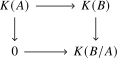 in \(\An_\bullet\).
Proof
We let \(C\) be the Waldhausen category defined by \(C=B\) as categories, with cofibrations being all maps but with weak equivalences being the maps whose cofiber lies in \(A\).
We observe then that the equivalence
\[
\Scons_{n+1}(B)=B^{[n]}
\]
induces an equivalence of the form
\[
\Scons_n(f\colon A\to B)=w_n(C)\, .
\]
Applying Proposition 20.8.2 to the admissible class of Waldhausen categories
given by small stable categories, with \(E=K\), and taking into account Remark 20.7.9,
we see that there is a canonical fiber sequence of the form
below.
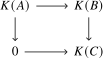 It suffices now to see that the morphism of Waldhausen categories
\(C\to B/A\) induced by the functor \(B\to B/A\) yields an equivalence of the form
\[
K(C)=K(B/A)\, .
\]
We want to understand the map
\[
{\underset{[m] : \Delta\catop}{\colim}\, } {\underset{[n] : \Delta\catop}{\colim}\, }
w_m(\Scons_{n}(C))^\simeq\to
{\underset{[m] : \Delta\catop}{\colim}\, } {\underset{[n] : \Delta\catop}{\colim}\, }
\Iso_m(\Scons_{n}(B/A))
\]
where \(\Iso_n=\Fun([n],(-)^\simeq)\).
The assignment
\[
[m]\mapsto w_m(\Scons_n(C))^\simeq
\]
is the nerve of the category of weak equivalences \(w(\Scons_n(C))\), whereas
\[
[m]\mapsto \Fun([m],\Scons_{n}(B/A)^\simeq)
\]
is the nerve of the anima \(\Scons_{n}(B/A)^\simeq\). Taking the colimit in the variable \([m]\)
amounts to consider the map
\[
\Pi_\infty(w(\Scons_n(C)))\to \Scons_{n}(B/A)^\simeq\, .
\]
It suffices to check that the latter is an equivalence for all \(n\).
The case \(n=0\) is obvious (we are comparing two terminal categories). For \(n>0\),
identifying \(\Scons_n\) with \((-)^{[n-1]}\), taking into account
Theorem 18.4.7
with \(P=[n-1]\), this is a particular case of Proposition 17.1.14.