Remark 8.3.19 (Directed univalence implies ordinary univalence). The preceding theorem has the following universal form. Consider the diagram
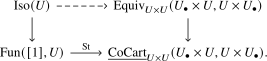 We claim that this is a pullback square and thus that the dashed map is an equivalence.
Indeed, given any category \(S\), we obtain a commutative square of the form
 This is a pullback square:
since this is a diagram of animae over \(\Map(S,U\times U)\),
it suffices to check this property fiber-wise over each object of \(\Map(S,U\times U)\),
which we already know.
The equivalence
\[
\Iso(U) \iso\Equiv_{U \times U}(U_{\bullet} \times U, U \times U_{\bullet})
\]
precisely means that the cocartesian fibration \(\pi\colon U_{\bullet} \to U\) is univalent in Voevodsky’s sense.
In practical terms, this is the precise way to say that there is a correspondence between
\(U\)-small cocartesian fibrations of the form \(p\colon X\to S\) and functors
of the form \(F\colon S\to U\): given a pullback square of the form
 \(p\) and \(F\) determine each other uniquely.