Remark 19.6.9. Let \(i\colon A\to B\) be an exact fully faithful functor between small stable categories, with Verdier quotient. Let \(W\) be the family of maps with fibers in \(A\).
Using the Yoneda embedding \[ B\hookrightarrow\Ind(B)=\Lex(B\catop,\Sp) \] we may see \(W\) as a small family of maps in \(\Ind(B)\). The \(W\)-local objects are thus those presheaves satisfying condition (iii) of Corollary 19.6.8. More precisely, if \(L_W\Ind(B)\) denotes the full subcategory of \(W\)-local objects in \(\Ind(B)\), the functor \(p^*\) induces a fully faithful and essentially surjective functor from \(\Ind(B/A)\) to \(L_W\Ind(B)\). Since \(p^*\) corresponds to the full embedding of \(L_W\Ind(B)\) to \(\Ind(B)\), its left adjoint \[ p_!\colon\Ind(B/A)\to\Ind(B) \] correspond to the \(W\)-localization functor \[ \loc_W\colon L_W\Ind(B)\to\Ind(B)\, . \] One can then use Proposition 18.4.2 to identify the localization of \(B\) by \(W\) with the smallest full subcategory of \(\Ind(B/A)\) stable under pushouts and containing objects of the form \(p(b)\) for \(b : B^\simeq\). Let \(\gamma\colon B\to L(B)\) be this localization.
We also get a Verdier quotient
of the form
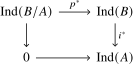 since \(i^*\) is a localization (having a fully faithful left adjoint \(i_!\)) and that the
objects of \(\Ind(B)\) that are sent to \(0\) through \(i^*\) precisely are the objects in the
essential image of \(p^*\) by Corollary 19.6.8,
so that we can apply Proposition 19.6.7
(for large stable categories, i.e. seeing \(\Ind(B)\) as a stable category in larger universe).