Theorem 19.6.15 (Thomason). Let \(i\colon A\to B\) be a fully faithful exact functor between small stable categories,
and let \(B/A\) be the associated Verdier quotient.
 By passing to idempotent completions, we obtain a cartesian square in \(\StabCat\)
of the form
 with \(i'\) fully faithful, and the induced functor
\[
B'/A'\to (B/A)'
\]
is an exact fully faithful functor that induces an equivalence after idempotent completion
\[
(B'/A')'\simeq(B/A)'\, .
\]
Moreover, the induced commutative square of (large) stable categories
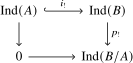 has the property that \(i_!\) is fully faithful and that \(p_!\) induces an equivalence
\[
\Ind(B)/\Ind(A)\simeq\Ind(B/A)\, .
\]
Proof
Since \(i\) is fully faithful, the induced functor \[ i_!\colon\PSh(A)\to\PSh(B) \] is fully faithful, hence its restriction \[ i_!\colon\Ind(A)\to\Ind(B) \] is fully faithful as well. Restricting further to compact objects thus yields an exact fully faithful functor \[ i'\colon A'\to B'\, . \] Since \(\Ind(C)=\Ind(C')\) for any small stable category \(C\), Remark 19.6.9 implies right away that the comparison functor \[ B/A\to B'/A' \] is fully faithful and induces an equivalence \[ \Ind(B/A)=\Ind(B'/A')\, . \] Passing to compact objects, this proves that \(B/A\) and \(B'/A'\) have the same idempotent completion.
Let us consider finally the commutative square in \(\StPrL_\omega\)
given by
In order to prove that this is both a pullback square and a pushout square of (large)
stable categories, we will apply Proposition 19.6.13.
In other words, it suffices to check that we have a six gluing functors datum
of the form
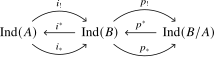 The existence of adjoint functors follows from
Theorem 18.2.8 and
Proposition 19.3.5. The only non-trivial property to be checked is the fact that
\(i^*\) and \(p_!\) form a jointly conservative family of functors. In other words, we have to check that, for
an object \(X\) of \(\Ind(B)\) with \(i^*(X)=0\) and \(p_!(X)=0\) we must have \(X=0\).
But by Corollary 19.6.8, the condition that \(i^*(X)=0\)
is equivalent to the condition that \(X\) is in the essential image of \(p^*\). If \(X=p^*(Y)\)
for some \(Y\), since \(p^*\) is fully faithful, we then have \(p_!(X)=Y\). Therefore, if \(p_!(X)=0\)
we must have \(Y=0\) hence \(X=0\) as well. Since \((-)_\omega\) preserves pullback squares (being a right adjoint),
this proves the theorem.