Lemma 20.7.7. Let \(C\) be a small admissible class of Waldhausen categories. The subcategory of additive equivalences has the following stability properties.
(i) Additive equivalences are stable under small sifted colimits: for any small sifted category and any natural transformation \(u\colon F\to G\) between \(I\)-indexed functors with values in \(\FunProd(\WaldCat_C,\An_{\bullet})\), if \(u_i\colon F_i\to G_i\) is an additive equivalence for all \(i : I^\simeq\), then the induced map \[ \underset{i : I}{\colim}\, u_i\colon \underset{i : I}{\colim}\, F_i \to \underset{i : I}{\colim}\, G_i \] is an additive equivalence.
(ii) The functor \(F\mapsto F^n\) preserves additive equivalences for all \(n\colon\N\).
(iii) The assignment \(F\mapsto F\circ\Scons_{n}\) preserves additive equivalences for all \(n : \N\).
(iv) The assignment \(F\mapsto F\circ w_n\) preserves additive equivalences for all \(n : \N\).
Proof
any morphism \(u\colon F\to G\) in \(\FunProd(\WaldCat_C,\An_{\bullet})\)
fits functorially in a commutative square of the form
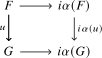 in which the two horizontal maps are additive equivalences, being the unit the adjunction \((\alpha,i)\)
with \(i\) fully faithful. Since \(u\) is an additive equivalence if and only if \(i\alpha(u)\) is
an isomorphism, property (i) follows from the fact that the functor \(i\alpha\) commutes with
small sifted colimits (since \(i\) has this property whereas \(\alpha\) commutes with all colimits).
Similarly, in order to prove assertion (ii), it suffices to check that, for any functor \[ F\colon\WaldCat_C\to\An_{\bullet} \] that commutes with finite products and any \(n : \N\), the canonical map \[ F^n\to i\alpha(F)^n \] is an additive equivalence. Equivalently, we have to see that for any additive functor \[ E\colon\WaldCat_C\to\An_{\bullet} \] the map above induces an identification of type \[ \Hom(i\alpha(F)^n,E)=\Hom(F^n,E)\, . \] Since both assignments \[ F\mapsto F^n\quadtext{and} F\mapsto i\alpha(F)^n \] commute with small sifted colimits and since any such \(F\) is a small sifted colimit of corepresentable functors, we may assume that there is a Waldhausen category \(A\) in the class \(C\) such that \(F=\Wald(A,-)^\simeq\). Since the category \(\WaldCat_C\) is semi-additive, we then have \[ F^n=\Wald(A^n,-)^\simeq\, . \] Since \(E\) commutes with finite products then have by the Yoneda lemma: \[ \Hom(F^n,E)=E(A^n)=E(A)^n\, . \] But since the category \(\Add(\WaldCat_C,\An_\bullet)\) is semi-additive as well, we also have \[ \Hom(i\alpha(F)^n,E)=\Hom(i\alpha(F),E)^n\, . \] Since \(\Hom(i\alpha(F),E)=\Hom(F,E)\), this proves property (ii).
The proof of assertion (iii) is similar. This is obvious for \(n\leq 1\) so that we may assume \(n>1\). Evaluating at each vertex of shape \((0,i)\) for \(1<i\leq n\), yields a natural transformation of the form \[ \Scons_n(A)\to A^{n-1} \] hence a functorial morphism of type \[ F(\Scons_{n}(A))\to F(A^{n-1})=F(A)^{n-1} \] for any functor \(F\) that commutes with finite products. Since \(F\mapsto F^{n-1}\) preserves additive equivalences, it suffices to prove that the map \[ F\circ\Scons_{n}\to F^{n-1} \] is an additive equivalence for all \(F\). Since this is a map between constructions that are compatible with small sifted colimits, it suffices to prove this in the case where \(F=\Wald(A,-)^\simeq\) for some Waldhausen category \(A\) in the class \(C\). By virtue of Lemma 20.7.4, there is then a canonical equivalence of type \[ F\circ\Scons_{n}=\Wald(\Scons_n(A),-)^\simeq \, . \] Therefore, for any additive functor \(E\) we have \[ \Hom(F,E)=E(\Scons_n(A))=E(A)^{n-1} \] by Corollary 20.4.11 (and an easy induction). We also have \(F^{n-1}=\Wald(A^{n-1},-)\) by semi-additivity of \(\WaldCat_C\), hence \(\Hom(F^{n-1},E)=E(A)^{n-1}\). This implies that \(\Hom(-,E)\) turns the map from \(F\circ\Scons_{n}\) to \(F^{n-1}\) to an equivalence and thus proves assertion (iii).
Finally, the natural map \(A\to w_n(A)\) induces a map \[ F\to F\circ w_n \] and it suffices to prove that the latter is an additive equivalence. Since this is a map between functors that preserve small sifted colimits and since \(F\) is a small sifted colimit of corepresentable functors, it suffices to prove this for \(F\) of the form \(\Wald(A,-)^\simeq\) for some \(A\) in the class \(C\). By virtue of Lemma 20.7.5, we then have \[ F\circ w_n=\Wald(w_n(A),-)^\simeq\, . \] Therefore, for any additive functor \(E\), the map \(A\to w_n(A)\) induces an equivalence \[ E(A)\cong E(w_n(A)) \] which is equivalent to \(\Hom(F\circ w_n,E)\to \Hom(F,E)\).
From Section 20.7, The universal property of Waldhausen construction.