Lemma 20.5.8. Let \(A\) be a Waldhausen category and \(n : \N\). The fully faithful right exact functor \(u\colon[n]\hookrightarrow\Fun([1],[n])\) defined by \(u(i)=(0,i)\) induces an equivalence \[ u^*\colon\Scons_n(A)\iso\Wald([n],A)\, . \]
Proof
It suffices to check that
\[
u^*\colon
\Fun([1],\Scons_n(A))^\simeq\to\Fun([1],\Wald([n],A))^\simeq
\]
is an equivalence. Given any Waldhausen category \(B\),
we can equip \(\Fun([1],B)\) with a Waldhausen structure
in which the weak equivalences and the cofibrations are defined termwise.
We then observe that
\[
\Fun([1],\Wald([n],A))=\Wald([n],\Fun([1],A))\quad\text{and}
\Fun([1],\Scons_n(A))=\Scons_n(\Fun([1],A))\, .
\]
Therefore, we see that it suffices to prove that
\[
u^*\colon\Scons_n(A)^\simeq\to\Wald([n],A)^\simeq
\]
is an equivalence. This is done by induction on \(n\).
For \(n=0\), this is clear: both sides are contractible.
For \(n=1\), both sides are equivalent to \(A^\simeq\)
and \(u^*\) is equivalent to the identity of \(A^\simeq\).
Given \(n>0\) for which the statement is known to be true,
we deduce the case of \(n+1\) as follows.
Let \(R_n\) be the full subcategory of \(\Fun([1],[n+1])\)
whose objects are the pairs of the form \((i,j)\) with
\(j\leq n\) or \(i=0\). The embedding
\[
v\colon R_n\hookrightarrow\Fun([1],[n+1])
\]
induces an equivalence
\[
v^*\colon\Scons(\Fun([1],[n+1]),A)^\simeq\iso
\Scons(R_n,A)^\simeq
\]
whose inverse is given by completing each diagram of the form
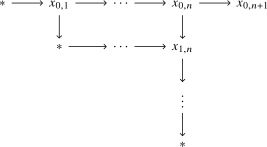 (in which \(x_{0,n}\to x_{0,n+1}\) is a cofibration) through pushouts (and a map to \(*\)).
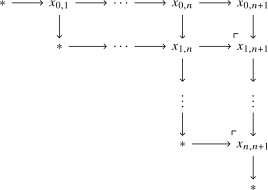 We see that there is a pullback square of the form
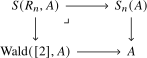 induced by the obvious embedding \(\Fun([1],[n])\hookrightarrow R_n\)
and the map \(w\colon [2]\hookrightarrow R_n\) defined by \(w(0)=(0,0)\),
\(w(1)=(0,n)\) and \(w(2)=(0,n+1)\).
Since there is a pullback of the form
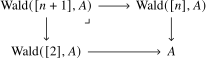 the induction hypothesis implies that there is a canonical equivalence
\[
\Scons(R_n,A)\simeq\Wald([n+1],A)\, .
\]