Proposition 13.1.16. Let \(f\colon A\to B\) be a functor between categories. We suppose that the following properties hold.
(i) The functor \(f\) is either weakly proper or weakly smooth.
(ii) For each object \(b\) of \(B\), the fiber \(A_b\) is weakly contractible.
Then \(f\) exhibits \(B\) as the localization of \(A\) by \[ W:=\sum_{b : B^\simeq}\Map([1],A_b) \] (the family of maps in \(A\) that are sent to identities in \(B\)).
Proof
We will prove the case where \(f\) is weakly proper (the weakly smooth case follows from the weakly proper one by considering \(f\catop\colon A\catop\to B\catop\)).
The universal property of localization gives a commutative triangle of the form
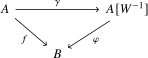 where \(\gamma\colon A\to A[W^{-1}]\) is the localization of \(A\) by \(W\).
We will show that \(\varphi\) is an equivalence.
We may choose a universe \(\Cat\) so that \(A\) and \(B\) are small.
The commutative triangle above thus gives rise to a commutative triangle of the form
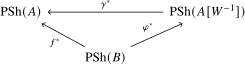 in which \(\gamma^*\) is fully faithful, with essential image those functors that send any map
in \(W\) to an isomorphism of \(\An\).
We claim that \(f^*\) is fully faithful. Equivalently, this means that, for any functor
of the form \(E\colon B\catop\to\An\), the unit map
\[
\eta_E\colon E\to f_*f^*(E)
\]
is an isomorphism. We observe that the restriction of \(f^*(E)\)
to the fiber \(A_b\) is the constant
functor with value \(E(b)\).
By virtue of Lemma 13.1.14 and Lemma 13.1.15
this implies that, for each object \(b\) of \(B\), there is a canonical
isomorphism of the form:
\[
\Hom(\Pi_{\infty}(A_b\catop),E(b))\simeq f_*f^*(E)(b)\, .
\]
Since \(A_b\) is weakly contractible, so is \(A_b\catop\) and, by Corollary 12.3.7,
the previous identification can be rewritten as:
\[
E(b)=f_*f ^*(E)(b)\, .
\]
This isomorphism agrees with the evaluation of \(\eta_E\) at \(b\), and this proves that \(f^*\) is fully faithful.
Since \(\gamma^*\) is fully faithful as well, the functor \(\varphi^*\) must also be fully faithful.
In order to prove that \(\varphi^*\) is an equivalence, it suffices to check that both fully faithful functors \(f^*\) and \(\gamma^*\) have the same essential image in \(\PSh(A)\). Since \(f^*\) is the composition of \(\varphi^*\) and \(\gamma^*\), it suffices to check that an object in the essential image of \(\gamma^*\) is in the essential image of \(f^*\). Let \(E\colon A\catop\to\An\) be a functor sending any map in \(W\) to an isomorphism of \(\An\). We will prove that the co-unit map \[ \varepsilon_E\colon f^*f_*(E)\to E \] is an isomorphism. Let \(a\) be an object of \(A\). The restriction of \(E\) to each fiber \(A_{f(a)}\catop\) sends each map to an isomorphism. Since the fiber is weakly contractible, this means that the restriction to the fiber is constant with value \(E(a)\). In other words, the functor \[a\colon [0]\to A_{f(a)}\catop\] induces isomorphisms \[ \lim_{A_{f(a)}\catop}\, E\vert_{A_{f(a)}\catop}\simeq \Hom(\Pi_{\infty}(A_{f(a)}\catop),E(a))\simeq E(a)\, . \] By virtue of Lemma 13.1.15, this means that there is a canonical isomorphism of the form \[ f_*(E)(f(a))=E(a)\, . \] The composition of this isomorphism with the defining identification \(f^*f_*(E)(a)=f_*(E)(f(a))\) coincides with the evaluation of \(\varepsilon_E\) at \(a\). Therefore, \(f^*f_*(E)=E\) and thus \(E\) lies in the essential image of \(f^*\). Since \(\varphi^*\) is an equivalence, so is its left adjoint \(\varphi_!\). This implies finally that the functor \(\varphi\) itself is fully faithful, by Proposition 12.2.11. By virtue of Proposition 11.2.11, it suffices now to prove that the map \[ \varphi^\simeq\colon (A[W^{-1}])^\simeq\to B^\simeq \] is a cover. By Corollary 11.2.7, it suffices to prove that \[ f^\simeq\colon A^\simeq\to B^\simeq \] is a cover. But condition (ii) tells us in particular that the projection \[ \pr_1\colon B^\simeq\times_B A\to B^\simeq \] induces an equivalence after applying the functor \(\Pi_{\infty}\). In other words, it exhibits \(B^\simeq\) as the localization of \(B^\simeq\times_B A\) by all maps. Therefore, by virtue of Corollary 11.2.16, the induced map \[ (\pr_1)\colon(B^\simeq\times_B A)^\simeq\to B^\simeq \] is a cover. To conclude, we observe that \((B^\simeq\times_B A)^\simeq=A^\simeq\) holds over \(B^\simeq\).