Theorem 12.3.16 (Yoneda lemma). Let \(C\) be a locally small category. There is an isomorphism \[ \Hom_{\Fun(C\catop,\An)}(h_C(x),F) \iso F(x), \] which is functorial in both variables \(F : \Fun(C\catop,\An)\) and \(x : C\catop\).
It is the unique functorial identification which extends the inverse of identification \[ \Hom_C(x,y) \iso \Hom_{\Fun(C\catop,\An)}(h_C(x),h_C(y)) \] on representable functors expressing the full faithfulness of the Yoneda embedding \(h_C\).
Proof
Choose a larger universe \(\Cat'\) in which \(C\) and \(\PSh(C)\) are small,
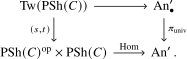
and write \(\An'\) for its category of animae. We have a Hom-functor
of the form:
 The Yoneda embedding of \(C\) being
fully faithful, it follows that the functor \(\id_{C\catop} \times h_C\) is fully faithful as well,
and hence the left Kan extension functor
\[
(\id_{C\catop} \times h_C)_!\colon \Fun(C\catop \times C, \An') \to \Fun(C\catop \times \PSh(C), \An')
\]
is fully faithful, by Proposition 12.2.11.
On the other hand, by virtue of Proposition 12.2.8, if
\[
i\colon\An\to\An'
\]
denotes the canonical full embedding, we get the identification
\[
(\id_{C\catop} \times h_C)_! (i \circ \Hom_C) = (h_C\catop \times \id_{\PSh(C)})^*(i\circ \Hom)
\]
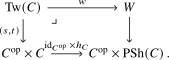
and, by a similar argument, the initiality of the functor \(w\) from Lemma 12.3.9
means that
\[
(\id_{C\catop} \times h_C)_! (i\circ \Hom_C) = i\circ \ev
\]
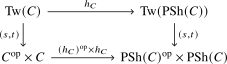
holds. Moreover, the full faithfulness of the Yoneda embedding can be expressed by saying that
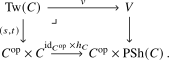
there is a pullback square of the form
 inducing a pullback square of the form
 By construction, we have a pullback square of the form
 The two identifications with \((\id_{C\catop}\times h_C)_!(i\circ\Hom_C)\)
give the asserted identification of functors. The last two pullback squares
show that its restriction to representable presheaves expresses the full
faithfulness of \(h_C\). Finally, full faithfulness of
\((\id_{C\catop}\times h_C)_!\) shows that this restriction determines the
identification uniquely.
These two descriptions identify the left fibrations classified by evaluation and by morphisms
out of representable presheaves. We therefore obtain the fully functorial statement.