For a small idempotent complete stable category \(A\), the Calkin category \(\Calk _{\kappa }(A)\) of Section 2.5 fits into a short exact sequence \(A \to \Ind (A)^{\kappa } \to \Calk _{\kappa }(A)\). For K-theory, the middle term is invisible: it admits countable coproducts, so its K-theory vanishes by the Eilenberg swindle, and \(K(\Calk _{\kappa }(A)) \simeq \Sigma K(A)\). We now extend this construction to dualizable categories, which may have no nonzero compact objects at all. Throughout this section, \(\kappa \) denotes an uncountable regular cardinal.
Let \(C\) be dualizable. By Theorem 3.20(1), \(C\) is generated under colimits by \(\omega _1\)-compact objects, hence by a set of \(\kappa \)-compact objects, so \(C\) is \(\kappa \)-compactly generated [Ramzi (2024a), Lemma A.21 and Addendum A.22]. By Proposition 3.17, the functor \(\colim \colon \Ind (C^{\kappa }) \to C\) thus admits a fully faithful, strongly continuous left adjoint \(\hat {y}\colon C \to \Ind (C^{\kappa })\). As in the proof of Theorem 3.16, its cofiber in \(\PrL _{\st }\) is compactly generated.
Definition 7.5 ([Efimov (2024), Definition 2.58]). Let \(C\) be a dualizable category. The continuous \(\kappa \)-Calkin category \(\Calk ^{\cont }_{\kappa }(C)\) is the small idempotent complete stable category of compact objects of the quotient \[ \Ind (C^{\kappa })/\hat {y}(C) \simeq \ker \big (\colim \colon \Ind (C^{\kappa }) \to C\big ), \] so that we have a strongly continuous localization sequence \[ C \xrightarrow {\hat {y}} \Ind (C^{\kappa }) \to \Ind (\Calk ^{\cont }_{\kappa }(C)). \]
Here the identification of the quotient with the kernel comes from Proposition 2.12: the right orthogonal of \(\hat {y}(C)\) consists of those \(X\) with \(\Map (x,\colim X) \simeq \Map (\hat {y}x,X) \simeq *\) for all \(x \in C\).
Remark 7.6. If \(C = \Ind (A)\) is compactly generated, the continuous Calkin category \(\Calk ^{\cont }_{\kappa }(C)\) of Definition 7.5 agrees with \(\Calk _{\kappa }(A)\) [Efimov (2024), Proposition 2.59]. Indeed, by Example 3.6, the functor \(\hat {y}\colon C \to \Ind (C^{\kappa })\) is \(\Ind (j)\) for the inclusion \(j\colon A \hookrightarrow C^{\kappa } = \Ind (A)^{\kappa }\), so by Theorem 2.17(1) its cofiber is \(\Ind \big ((\Ind (A)^{\kappa }/A)^{\idem }\big ) = \Ind (\Calk _{\kappa }(A))\).
Construction 7.7. Let \(F\colon C \to D\) be a strongly continuous functor between dualizable categories. Then \(F\)
preserves \(\kappa \)-compact objects, since \(F^R\) preserves colimits, so it restricts to a functor \(F^{\kappa }\colon C^{\kappa } \to D^{\kappa }\). The left adjoint of
\(\colim \colon \Ind (C) \to C\) is the composite of \(\hat {y}\colon C \to \Ind (C^{\kappa })\) with the inclusion \(\Ind (C^{\kappa }) \subseteq \Ind (C)\): indeed, by the proof of Proposition 3.17, the colimit functor of \(\Ind (C)\) factors as
\(\colim _{\kappa } \circ r\), where \(r\) is the right adjoint of the inclusion \(\Ind (C^{\kappa }) \subseteq \Ind (C)\). Since \(\Ind (F)\) restricts to \(\Ind (F^{\kappa })\) on \(\Ind (C^{\kappa })\), Proposition A.27 gives a commutative square
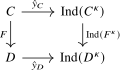 of strongly continuous functors. Passing to cofibers in \(\Pr ^{\mathrm {LL}}_{\st }\), which are computed in \(\PrL _{\st }\) by Proposition 7.1, we obtain a
strongly continuous functor \(\Ind (\Calk ^{\cont }_{\kappa }(C)) \to \Ind (\Calk ^{\cont }_{\kappa }(D))\). It preserves compact objects, and hence restricts to an exact functor \[ \Calk ^{\cont }_{\kappa }(F)\colon \Calk ^{\cont }_{\kappa }(C) \to \Calk ^{\cont }_{\kappa }(D). \]
The squares above are coherent in \(F\): the colimit functors form a natural transformation \(\Ind ((-)^{\kappa }) \to \id \), and taking
mates along \(\hat {y}_C \dashv \colim _C\) gives the natural maps \(\hat {y}_D F \to \Ind (F^{\kappa })\hat {y}_C\) used above. These are isomorphisms for strongly continuous \(F\),
by Proposition A.27. The compatibility of mates with composition supplies a natural transformation \(\id \to \Ind ((-)^{\kappa })\) in \(\Pr ^{\mathrm {LL}}_{\st }\). Applying
the cofiber functor and then taking compact objects therefore defines a functor \(\Calk ^{\cont }_{\kappa }\colon \Pr ^{\dual } \to \Cat _{\perf }\), including its higher
coherences.
Under the identifications of the quotients with kernels, the functor \(\Ind (\Calk ^{\cont }_{\kappa }(C)) \to \Ind (\Calk ^{\cont }_{\kappa }(D))\) is the restriction of \(\Ind (F^{\kappa })\). Indeed, the functors \(\colim _D \circ \Ind (F^{\kappa })\) and \(F \circ \colim _C\) preserve colimits and agree on \(C^{\kappa }\), so \(\Ind (F^{\kappa })\) maps \(\ker (\colim _C)\) into \(\ker (\colim _D)\). The left adjoint \(q_C\) of the inclusion \(\ker (\colim _C) \subseteq \Ind (C^{\kappa })\) is given by \(q_C(X) = \cofib (\hat {y}_C\colim _C X \to X)\). Using the square above, we get \(\Ind (F^{\kappa })(q_CX) \simeq q_D(\Ind (F^{\kappa })X)\), which identifies the functor induced on the quotients with the restriction of \(\Ind (F^{\kappa })\).
The main property of the continuous Calkin construction is that it preserves short exact sequences. We first fix terminology.
Definition 7.8. A short exact sequence of dualizable categories is a strongly continuous localization sequence \(C \to D \to E\) in \(\PrL _{\st }\) (Definition 2.11) in which \(C\), \(D\) and \(E\) are dualizable. Equivalently, it is a sequence in \(\Pr ^{\dual }\) which is both a fiber sequence and a cofiber sequence in \(\PrL _{\st }\) (Proposition 2.12).
By Proposition 3.19, it suffices to require that \(D\) is dualizable. A short exact sequence of dualizable categories is also both a fiber sequence and a cofiber sequence in \(\Pr ^{\dual }\), see Remark 7.23 below.
Proposition 7.9 ([Efimov (2024), Proposition 2.61]). The functor \(\Calk ^{\cont }_{\kappa }\colon \Pr ^{\dual } \to \Cat _{\perf }\) sends short exact sequences of dualizable categories to short exact sequences.
Proof.
Let \(C \xrightarrow {F} D \xrightarrow {G} E\) be a short exact sequence of dualizable categories. As shown above, \(C\) and \(D\) are \(\kappa \)-compactly
generated. Since \(G\) preserves \(\kappa \)-compact objects, [Ramzi (2024a), Proposition A.26] shows that \(C^{\kappa } \to D^{\kappa } \to E^{\kappa }\) is a short exact sequence. By Theorem 2.17(1), the
sequence \(\Ind (C^{\kappa }) \to \Ind (D^{\kappa }) \to \Ind (E^{\kappa })\) is a strongly continuous localization sequence. By Construction 7.7, we obtain a commutative diagram 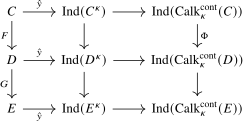 in
which the rows and the first two columns are cofiber sequences in \(\PrL _{\st }\). Since colimits commute with
colimits, the third column is a cofiber sequence in \(\PrL _{\st }\) as well.
We claim that \(\Phi \) is fully faithful. By Construction 7.7, \(\Phi \) is identified with the restriction of \(\Ind (F^{\kappa })\) to the kernels of the colimit functors. Since \(F\) is fully faithful, so are \(F^{\kappa }\) and \(\Ind (F^{\kappa })\), and hence so is \(\Phi \).
Since \(\Phi \) is fully faithful and colimit-preserving, its essential image is closed under colimits, and the cofiber sequence of the third column is a localization sequence by Proposition 2.12(1). All functors involved preserve compact objects, so it is strongly continuous. By Theorem 2.17(2), the sequence \(\Calk ^{\cont }_{\kappa }(C) \to \Calk ^{\cont }_{\kappa }(D) \to \Calk ^{\cont }_{\kappa }(E)\) of compact objects is short exact. □
In the talk, the fully faithfulness of \(\Phi \) was explained by passing to the right adjoints of the horizontal functors: the colimit functors are compatible with the vertical functors, and the kernel of a map between fully faithful functors is fully faithful.