We now make this precise. In this section \(C\) is a category with filtered colimits, not necessarily stable; the stable case is the subject of Section 3.2. Besides the definition, the key notion is that of a compact morphism, which in compactly assembled categories takes over the role played by compact objects in compactly generated ones. We also show that the compactly assembled categories are precisely the retracts of compactly generated ones (Theorem 3.8), and introduce the corresponding class of strongly continuous functors.
Definition 3.1. A category \(C\) is called compactly assembled if it is accessible, admits filtered colimits, and the colimit functor \(\colim \colon \Ind (C) \to C\) admits a left adjoint \(\hat {y}\colon C \hookrightarrow \Ind (C)\).
Note that \(\hat {y}\) is automatically fully faithful, since its double right adjoint \(y\colon C \hookrightarrow \Ind (C)\) is fully faithful (Lemma A.26).
Since \(y\) is fully faithful, the counit \(\colim y \to \id \) is invertible. Inverting it gives a map \(\id \to \colim y\), which under the adjunction \(\hat {y} \dashv \colim \) corresponds to a natural transformation \[ \hat {y} \to y. \] By construction, applying \(\colim \) to \(\hat {y}(x) \to y(x)\) gives (up to the identifications \(\colim \hat {y}(x) \simeq x \simeq \colim y(x)\)) the identity of \(x\).
Lemma 3.2. Let \(C\) be compactly assembled and \(x \in C\). Then \(x\) is compact if and only if the map \(\hat {y}(x) \to y(x)\) is an equivalence.
Proof.
Consider the natural transformation \[ \Map _{\Ind (C)}(y(x),-) \to \Map _C(x,\colim (-)) \] of functors \(\Ind (C) \to \An \) given by applying \(\colim \) and using \(\colim y(x) \simeq x\). Composing with the adjunction equivalence \(\Map _C(x,\colim (-)) \simeq \Map _{\Ind (C)}(\hat {y}(x),-)\), it corresponds by the Yoneda lemma to the map \(\hat {y}(x) \to y(x)\), by the description of this map given above. Hence \(\hat {y}(x) \to y(x)\) is an equivalence if and only if this transformation is an equivalence. Evaluated at \(\quotcolim _j z_j\), it is the canonical map \[ \colim _j \Map _C(x,z_j) \simeq \Map _{\Ind (C)}\big (y(x),\quotcolim _j z_j\big ) \to \Map _C\big (x,\colim _j z_j\big ), \] where the first equivalence holds as \(y(x)\) is compact in \(\Ind (C)\). This is an equivalence for all filtered diagrams \((z_j)\) if and only if \(x\) is compact. □
Compact objects of \(C\) are those \(x\) for which maps out of \(x\) into a filtered colimit factor through some stage of the colimit. The following relative version of this notion is the basic tool for studying compactly assembled categories.
Definition 3.3. Let \(C\) be a category with filtered colimits. A morphism \(f\colon x \to x'\) in \(C\) is called compact if the natural transformation \[ f^*\colon \Map _C\big (x',\colim (-)\big ) \to \Map _C\big (x,\colim (-)\big ) \] of functors \(\Ind (C) \to \An \) factors through the natural transformation \[ \Map _{\Ind (C)}\big (y(x),-\big ) \to \Map _C\big (x,\colim (-)\big ) \] given by applying \(\colim \) and using \(\colim y(x) \simeq x\).
Evaluated at an ind-object \(Z = \quotcolim _j z_j\), the second transformation is the canonical map \(\colim _j \Map _C(x,z_j) \to \Map _C(x,\colim _j z_j)\). So informally, \(f\) is compact if for every map \(g\colon x' \to \colim _j z_j\) the composite \(gf\) factors through some stage \(z_j\), in a way which is natural in the filtered diagram \((z_j)_j\). By definition, \(x\) is compact if and only if the second transformation is an equivalence; in that case every morphism \(x \to x'\) and every morphism \(x'' \to x\) is compact.
Remark 3.4. Compact morphisms form a two-sided ideal: if \(f\colon x \to x'\) is compact and \(k\colon w \to x\) and \(h\colon x' \to x''\) are arbitrary, then \(hfk\) is compact. Indeed, given a factorization \(\theta \colon \Map _C(x',\colim (-)) \to \Map _{\Ind (C)}(y(x),-)\) of \(f^*\), the composite \(y(k)^* \circ \theta \circ h^*\) is a factorization of \((hfk)^* = k^*f^*h^*\).
Lemma 3.5. Let \(C\) be compactly assembled and let \(f\colon x \to x'\) be a morphism in \(C\).
- (1)
-
The morphism \(f\) is compact if and only if \(y(f)\colon y(x) \to y(x')\) factors through the map \(\hat {y}(x') \to y(x')\).
- (2)
-
The identity \(\id _x\) is a compact morphism if and only if \(x\) is a compact object.
Proof.
(1) Write \(\varepsilon \colon \hat {y}(x') \to y(x')\), and recall that \(\colim (\varepsilon )\) is the identity of \(x'\). By the adjunction \(\hat {y} \dashv \colim \), we have \(\Map _C(x',\colim (-)) \simeq \Map _{\Ind (C)}(\hat {y}(x'),-)\), so by the Yoneda lemma, natural transformations \(\theta \colon \Map _C(x',\colim (-)) \to \Map _{\Ind (C)}(y(x),-)\) correspond to maps \(g\colon y(x) \to \hat {y}(x')\), via \(\theta = g^*\). The composite of \(g^*\) with the transformation \(\Map _{\Ind (C)}(y(x),-) \to \Map _C(x,\colim (-))\) is precomposition with \(\colim (g)\colon x \to x'\). Hence \(f\) is compact if and only if there is a map \(g\colon y(x) \to \hat {y}(x')\) with \(\colim (g) \simeq f\). If \(\varepsilon g \simeq y(f)\), then \(\colim (g) \simeq \colim (\varepsilon g) \simeq f\). Conversely, if \(\colim (g) \simeq f\), then \(\varepsilon g\) and \(y(f)\) are maps \(y(x) \to y(x')\) with the same image under \(\colim \); since \(\colim \colon \Map _{\Ind (C)}(y(x),y(x')) \to \Map _C(x,x')\) is inverse to the equivalence induced by the fully faithful functor \(y\), we get \(\varepsilon g \simeq y(f)\).
(2) By (1), \(\id _x\) is compact if and only if \(\varepsilon \colon \hat {y}(x) \to y(x)\) admits a section \(g\). In that case, \(g\varepsilon \colon \hat {y}(x) \to \hat {y}(x)\) corresponds under the adjunction to \(\colim (g)\colon x \to x\), which is the identity since \(\colim (\varepsilon g) = \id _x\) and \(\colim (\varepsilon ) = \id _x\). Hence \(g\varepsilon \simeq \id \), so \(\varepsilon \) is an equivalence and \(x\) is compact by Lemma 3.2. The converse is clear. □
Example 3.6. If \(C\) is accessible and compactly generated, then \(C\) is compactly assembled. Indeed, if \(C = \Ind (C_0)\) with \(C_0\) small, then \[ \hat {y} = \Ind (y_{C_0})\colon \Ind (C_0) \to \Ind (\Ind (C_0)), \] where \(y_{C_0}\colon C_0 \hookrightarrow \Ind (C_0) = C\) is the Yoneda embedding. When \(C\) is cocomplete, we may take \(C_0=C^{\omega }\) by [SHT, Proposition 23.3.7].
The following example explains the terminology, and will be generalized in Chapter 9.
Example 3.7 (Continuous posets, [Johnstone and Joyal (1982); Gierz et al. (2003)]). Let \(P\) be a partially ordered set admitting directed joins, regarded as a category. Then \(\Ind (P)\) is the poset of ideals of \(P\), i.e. non-empty directed downward closed subsets \(I \subseteq P\), ordered by inclusion, and \(\colim \colon \Ind (P) \to P\) sends \(I\) to its join \(\bigvee I\). The functor \(y\) sends \(x\) to the principal ideal \({\downarrow }x\), which is the largest ideal with join \(\leq x\). A left adjoint \(\hat {y}\), if it exists, sends \(x\) to the smallest ideal \(I\) with \(x \leq \bigvee I\).
Say that \(y\) is way below \(x\), written \(y \ll x\), if \(y \in I\) for every ideal \(I\) with \(x \leq \bigvee I\); taking \(I = {\downarrow }x\) shows that \(y \ll x\) implies \(y \leq x\). Then \(\hat {y}\) exists if and only if for every \(x \in P\) the set \({\downarrow \!\!\downarrow }x = \{y \in P \mid y \ll x\}\) is directed with join \(x\), in which case \(\hat {y}(x) = {\downarrow \!\!\downarrow }x\); we prove this in Proposition 5.19. Posets with this property are classically called continuous. An element \(x\) is compact if and only if \(x \ll x\), in accordance with Lemma 3.2. For example:
- (1)
-
In the interval \([0,1]\), we have \(y \ll x\) if and only if \(y < x\) or \(y = 0\). So \([0,1]\) is continuous, and its only compact element is \(0\).
- (2)
-
Let \(X\) be a locally compact Hausdorff space and let \(\mathrm {Open}(X)\) be the poset of open subsets. Then \(U \ll V\) if and only if there exists a compact subset \(K \subseteq X\) with \(U \subseteq K \subseteq V\), and \(\mathrm {Open}(X)\) is continuous. The compact elements are the compact open subsets; for \(X = \R ^n\) the only one is \(\emptyset \).
- (3)
-
The power set of a set \(S\) is continuous, and in fact algebraic, i.e. compactly generated: the compact elements are the finite subsets, and every subset is the directed union of its finite subsets.
Note how example (2) foreshadows the fact that \(\Shv (\R ^n;\Sp )\) is dualizable but has no nonzero compact objects. Continuous posets are discussed in more detail, with proofs, in Section 5.3.
The following theorem gives an alternative characterization of compactly assembled categories, which shows that they are precisely the retracts of compactly generated ones.
Theorem 3.8 (Lurie, [Lurie (2018), Definition 21.1.2.1 and Theorem 21.1.2.10]). Let \(C\) be a category with filtered colimits. Then the following are equivalent:
- (1)
-
\(C\) is compactly assembled;
- (2)
-
There exists a small category \(D\) such that \(C\) is a retract of \(\Ind (D)\) as a category with filtered colimits.
Proof.
(1) \(\implies \) (2): We have an adjunction between \(\hat {y}\colon C \hookrightarrow \Ind (C)\) and \(\colim \colon \Ind (C) \to C\). Since \(\hat {y}\) is fully faithful, this exhibits \(C\) as a retract of \(\Ind (C)\), with both functors preserving filtered colimits. To ensure we may pick \(D\) small, write \(C = \Ind _{\kappa }(C^{\kappa })\), with \(C^{\kappa }\) small (Theorem A.17). Since \(\Ind (C) = \bigcup _{\lambda }\Ind (C^{\lambda })\) (Construction A.21) and \(C^{\kappa }\) is small, we may find some regular cardinal \(\lambda \) such that \(\hat {y}(C^{\kappa }) \subseteq \Ind (C^{\lambda })\). Since the inclusion \(\Ind (C^{\lambda }) \subseteq \Ind (C)\) preserves filtered colimits, it follows that in fact \(\hat {y}(C) \subseteq \Ind (C^{\lambda })\). So it follows that \(C\) is already a retract of \(\Ind (C^{\lambda })\), giving the claim.
(2) \(\implies \) (1): Assume we have \(u\colon C \hookrightarrow \Ind (D)\) with retraction \(v\colon \Ind (D) \to C\), and assume \(u\) and \(v\) preserve filtered colimits. It follows that \(C\) is accessible: we have \[ C = \lim \big ( \dots \xrightarrow {uv} \Ind (D) \xrightarrow {uv} \Ind (D)\big ), \] and the subcategory \(\mathrm {Acc} \subseteq \widehat {\Cat }\) of accessible categories and accessible functors is closed under limits in \(\widehat {\Cat }\) (Theorem A.18).
To show the existence of \(\hat {y}\), consider the following commutative diagram: 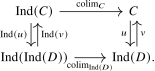 It follows that \(\colim _C\) is a retract
of \(\colim _{\Ind (D)}\). So we are done in light of Lemma A.22 in the appendix. □
Definition 3.9. Let \(C\) and \(D\) be compactly assembled. A functor \(f\colon C \to D\) is called strongly continuous if
it preserves filtered colimits and commutes with \(\hat {y}\), meaning that the mate transformation \[ \hat {y}_D f \to \Ind (f) \hat {y}_C \] of the
commutative square 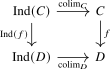 is a natural isomorphism.
Remark 3.10. Assume \(f\) admits a right adjoint \(g\colon D \to C\). Then the condition that \(f\) is strongly continuous is equivalent to \(g\) preserving filtered colimits, see Proposition A.27.