Lurie’s definition of \(\infty \)-operads uses finite pointed sets, or equivalently spans with injective backwards leg. We show that restriction to these spans induces an equivalence with the definition used in this book. The proof uses envelopes: both definitions identify \(\infty \)-operads with the same full subcategory of symmetric monoidal \(\infty \)-categories over \((\Fin ,\amalg )\).
Definition 19.4.1. Given a finite set \(I\), we write \(I_+ := I \sqcup *\) for the resulting finite pointed set. A morphism \(f\colon I_+ \to J_+\) of finite pointed sets is called inert if on the preimage of \(J\) it restricts to a bijection \(f^{-1}(J) \iso J\). We say that \(f\) is active if \(f^{-1}(*) = \{*\}\).
Given a finite set \(I\), the Segal map \(\rho _i\colon I_+ \to \{i\}_+\) for \(i \in I\) is defined as the map that is the identity on \(\{i\}\) and sends all other \(j \in I \setminus \{i\}\) to the basepoint.
Remark 19.4.2. Recall from Lemma 5.3.8 that there is an equivalence \[ \Span (\Fin ,\inj ,\all ) \simeq \Fin _*, \] given on objects by sending \(I\) to \(I_+\) and on morphisms by sending a span \(I \xhookleftarrow {f} K \xrightarrow {g} J\) to the pointed map \(h\colon I_+ \to J_+\) given by \(h(i) = g(k)\) whenever \(i = f(k)\) is in the image of \(f\) and \(h(i) = *\) otherwise. Under this equivalence, the inert maps in \(\Fin _*\) correspond to the backwards spans \(I \xhookleftarrow {f} K \xrightarrow {=} K\), and the active maps in \(\Fin _*\) correspond to the forward spans \(I \xleftarrow {=} I \xrightarrow {g} J\). The Segal maps \(\rho _i\) correspond to the backwards spans \[ I \hookleftarrow \{i\} \xrightarrow {=} \{i\}. \] We will write \(\Fin _* \hookrightarrow \Span (\Fin )\) for the inclusion of the subcategory \(\Span (\Fin ,\inj ,\all )\).
Definition 19.4.3 ([Lurie (2017), Definition 2.1.1.10]). An \(\infty \)-operad in the sense of Lurie is a pair \((\Oo ^{\otimes }, p_{\Oo })\) consisting of an \(\infty \)-category \(\Oo ^{\otimes }\) equipped with a functor \(p_{\Oo }\colon \Oo ^{\otimes } \to \Fin _*\). Writing \(\Oo ^\otimes _I\) for the fiber over \(I_+\), we require the following conditions:
- (1)
-
For any inert morphism \(f\colon I_+ \to J_+\) and any object \(X \in \Oo ^{\otimes }_I\) there is a \(p_{\Oo }\)-cocartesian lift \(X \to Y\) of \(f\) in \(\Oo ^{\otimes }\).
- (2)
-
Let \(X\) and \(Y\) be objects of \(\Oo ^{\otimes }\) and let \(I_+ := p_{\Oo }(X)\) and \(J_+ := p_{\Oo }(Y)\). For every \(j \in J\), let \(Y \to Y_j\) denote a \(p_{\Oo }\)-cocartesian lift of the Segal map \(\rho _j \colon J_+ \to \{j\}_+\). Then the induced commutative square
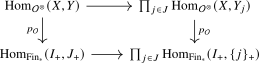
is a pullback square.
- (3)
-
For every finite collection \(\{X_j\}_{j \in J}\) of objects \(X_j \in \Oo ^{\otimes }_{\{j\}}\), there exists an object \(X \in \Oo ^{\otimes }_J\) and a collection of \(p_{\Oo }\)-cocartesian morphisms \(X \to X_j\) covering \(\rho _j \colon J_+ \to \{j\}_+\).
We say a functor \(f\colon \Oo ^{\otimes } \to \Pp ^{\otimes }\) over \(\Fin _*\) is a morphism of Lurie-\(\infty \)-operads if it preserves cocartesian morphisms over inerts. We let \(\Op _\infty ^{\mathrm {Lurie}} \subseteq (\Cat _{\infty })_{/\Fin _*}\) denote the \(\infty \)-category of the Lurie \(\infty \)-operads and their morphisms.
Let \(\Ff _{\mathrm {Lurie}} := (\Fin ,\Fin _{\inj },\Fin )\), so that \(\Span (\Ff _{\mathrm {Lurie}}) \simeq \Fin _*\).
Lemma 19.4.4. Under the equivalence \(\Span (\Ff _{\mathrm {Lurie}}) \simeq \Fin _*\), the \(\Ff _{\mathrm {Lurie}}\)-\(\infty \)-operads of Definition 19.3.8 are precisely the \(\infty \)-operads in the sense of Lurie, and the two notions of morphism agree. In particular, there is a canonical equivalence \[ \Op _{\Ff _{\mathrm {Lurie}}} \simeq \Op _\infty ^{\mathrm {Lurie}}. \]
Proof. Condition (1) in the two definitions is the same. Suppose first that \(p_{\Oo }\colon \Oo ^\otimes \to \Fin _*\) is an \(\infty \)-operad in the sense of Lurie. The functor \[ \Oo ^\otimes _J \longrightarrow \prod _{j \in J}\Oo ^\otimes _{\{j\}} \] induced by cocartesian transport along the Segal maps is essentially surjective by condition (3) of Definition 19.4.3. It is fully faithful as well: condition (2), restricted to the fiber over \(\id _{J_+}\), identifies the hom anima in \(\Oo ^\otimes _J\) with the product of the hom animae in the fibers over the singletons, using cocartesian transport along the Segal maps on the sources. Thus condition (2) holds for the decomposition of \(J\) into singletons, and hence for every finite decomposition by grouping the singleton factors. Condition (3) follows similarly from condition (2): apply it to the singleton decomposition of \(J\) and to those of the summands \(J_i\), and group the resulting factors according to \(J = \bigsqcup _i J_i\).
Conversely, if \(\Oo \) is an \(\Ff _{\mathrm {Lurie}}\)-\(\infty \)-operad, condition (1) gives the required cocartesian lifts of inert maps. Specializing condition (3) to the decomposition of \(J\) into singletons gives condition (2) of Definition 19.4.3, while condition (2) gives condition (3). Finally, in both cases a morphism is a functor preserving cocartesian morphisms over inert maps. □
Construction 19.4.5. Using Lemma 19.4.4, Proposition 5.3.9, we define the Lurie operadic envelope \[ \Env ^{\mathrm {Lurie}}\colon \Op _\infty ^{\mathrm {Lurie}} \longrightarrow \Cat _\infty ^\otimes \] as the functor \(\Env _{\Ff _{\mathrm {Lurie}}}\) of Proposition 19.3.10, followed by the equivalence from \(\Ff _{\mathrm {Lurie}}\)-monoidal \(\infty \)-categories to symmetric monoidal \(\infty \)-categories.
Lemma 19.4.6. If \(\Oo = (\Oo ^{\otimes },p_{\Oo })\) is an \(\infty \)-operad in the sense of Definition 14.1.1, then its pullback \(p_{\Pp }\colon \Pp ^{\otimes } := \Oo ^{\otimes } \times _{\Span (\Fin )} \Fin _* \to \Fin _*\) is an \(\infty \)-operad in the sense of Lurie. Moreover, forming pullbacks along the inclusion \(\Fin _* \hookrightarrow \Span (\Fin )\) induces a restriction functor \[ \Op _{\infty } \to \Op _{\infty }^{\mathrm {Lurie}}. \]
Proof. Any \(p_{\Oo }\)-cocartesian lift of a backwards span \(I \hookleftarrow J \xrightarrow {=} J\) will still be \(p_{\Pp }\)-cocartesian, verifying condition (1). Condition (2) is immediate from Lemma 14.1.13. Condition (3) is immediate from condition (ii) in Proposition 14.1.12. The claim on morphisms is checked similarly. □
Lemma 19.4.7. Let \[ u\colon \Fin _* \simeq \Span (\Fin ,\inj ,\all ) \hookrightarrow \Span (\Fin ) \] be the inclusion, and let \(\Rr _*\) and \(\Rr \) denote the forward morphisms in \(\Fin _*\) and \(\Span (\Fin )\), respectively. For every functor \(p\colon E \to \Span (\Fin )\), there is a natural equivalence of functors over \(\Fin _*\) \[ u^*E_{\Rr }(p) \simeq E_{\Rr _*}(u^*p). \]
Proof. By the pullback formula in Construction 19.2.2, it suffices to construct a natural equivalence \[ \Fin _* \times _{\Span (\Fin ),t}\Ar _{\Rr }(\Span (\Fin )) \simeq \Ar _{\Rr _*}(\Fin _*) \] compatible with the target functors to \(\Fin _*\) and the source functors to \(\Span (\Fin )\), using \(u\circ s\) on the right. The objects on both sides are forward spans, equivalently maps of finite sets \(r\colon I \to J\). A morphism on the left is a commutative square in \(\Span (\Fin )\)

in which \(g\) belongs to \(\Fin _*\). The composite \(gr\) has injective backwards leg because this leg is obtained by pulling back the injective backwards leg of \(g\) along \(r\). Since \(r'\) is a forward map, the backwards leg of \(r'f\) is the backwards leg of \(f\). The equivalence \(r'f \simeq gr\) therefore shows that \(f\) also belongs to \(\Fin _*\). As \(\Fin _* \hookrightarrow \Span (\Fin )\) is a wide subcategory inclusion, its hom animae are unions of components, so the identification making the square commute also lies in the corresponding hom anima of \(\Fin _*\). Thus the displayed square is a morphism in \(\Ar _{\Rr _*}(\Fin _*)\). This identifies the two arrow categories compatibly with source and target, and pulling back along \(p\) proves the claim. □
Proposition 19.4.8 ([Barkan et al. (2022), Corollary 5.1.15]). The restriction functor \(\Op _{\infty } \to \Op _{\infty }^{\mathrm {Lurie}}\) is an equivalence.
Proof. By Lemma 19.4.4, we may work with \(\Ff _{\mathrm {Lurie}}\)-\(\infty \)-operads. The envelope of the terminal such \(\infty \)-operad is \((\Fin ,\amalg )\), by the same calculation as in Lemma 19.3.15. Thus Lemma 19.2.9, followed by the Segal equivalence of Proposition 5.3.9, gives a fully faithful functor \[ \Env ^{\mathrm {Lurie}}\colon \Op _\infty ^{\mathrm {Lurie}} \longrightarrow (\Cat _\infty ^\otimes )_{/(\Fin ,\amalg )}. \] In these envelopes, objects are again tuples of colors, with tensor product given by concatenation, as in Lemma 19.3.13. The Segal condition therefore gives condition (1) of Proposition 19.3.19. The hom-anima calculation of Lemma 19.3.14 also applies, using condition (2) of Definition 19.4.3 over forward maps, and gives condition (2) of that proposition. Hence the essential image of \(\Env ^{\mathrm {Lurie}}\) is contained in that of \(\Env \).
Conversely, let \(u\colon \Fin _* \hookrightarrow \Span (\Fin )\) be the inclusion and let \(\Oo \) be an \(\infty \)-operad over \(\Span (\Fin )\). Applying Lemma 19.4.7 to \(p_{\Oo }\) identifies the cocartesian fibration defining \(\Env ^{\mathrm {Lurie}}(u^*\Oo )\) with the restriction of the one defining \(\Env (\Oo )\). Under the Segal equivalence, this gives a natural symmetric monoidal equivalence \[ \Env ^{\mathrm {Lurie}}(u^*\Oo ) \simeq \Env (\Oo ). \] It is compatible with the maps to \((\Fin ,\amalg )\) by naturality, so the two envelope functors have the same essential image. We obtain a naturally commutative diagram
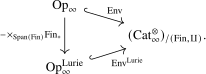
Both diagonal functors are equivalences onto the same essential image. It follows by 2-out-of-3 that the left vertical functor is an equivalence, as desired. □
Remark 19.4.9. For a classical colored operad \(\Oo \), restricting the \(\infty \)-operad of Proposition 14.2.4 along \(\Fin _*\hookrightarrow \Span (\Fin )\) recovers Lurie’s category of operators [Lurie (2017), Construction 2.1.1.7]. Indeed, spans with injective left leg are partial maps, and their operation labels compose by substitution.