Lemma 9.4.5 (Base change of fully faithful right adjoints). Let \(p'\colon X'\to S'\) be a functor such that, for every functor
\(h\colon [1]\times T\to S'\), the base change of the endpoint inclusion
\(\{1\}\times T\hookrightarrow[1]\times T\) along the induced functor
\(X'\times_{S'}([1]\times T)\to[1]\times T\) is terminal. Consider a pullback square
 in which \(v'\) is a fully faithful right adjoint. Then \(u'\) is terminal.
Proof
Let \(w\colon S' \to S''\) be a left adjoint of \(v'\), with counit isomorphism
\(\varepsilon\colon wv' \iso \id_{S''}\) and unit
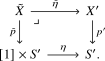
\(\eta\colon \id_{S'} \to v'w\). Form the pullback
 Consider the diagram
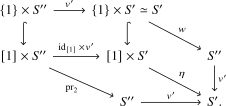 Pulling back this diagram along \(p'\) gives
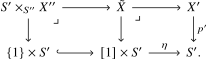
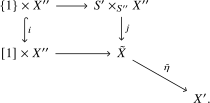 The map \(i\) is terminal, and \(j\) is terminal by the endpoint hypothesis since it is a
pullback of \(\{1\} \times S' \hookrightarrow [1] \times S'\):
 To show that \(u'\colon X'' \to X'\) is terminal, let \(q\colon Z \to X'\) be a right
fibration. The preceding commutative square over \(X'\) induces a commutative square
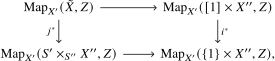 where the two vertical maps are equivalences since \(i\) and \(j\) are terminal. Hence there is
an equivalence
\[
\Map_{X'}(\tilde{X}, Z) \iso \Map_{X'}(S' \times_{S''} X'', Z)
\times_{\Map_{X'}(X'',Z)} \Map_{X'}([1] \times X'', Z).
\]
We now describe the retract explicitly. Denote the fiber product on the right by \(P_Z\), and
denote the displayed equivalence by
\[
e_Z\colon \Map_{X'}(\tilde{X},Z) \longrightarrow P_Z.
\]
Let \(r\colon \tilde{X}\to X'\) be the structural functor. Restricting the defining pullback
of \(\tilde{X}\) to \(\{0\}\times S'\), where \(\eta\) is the identity, gives a section
\(s\colon X'\to\tilde{X}\) with \(rs=\id_{X'}\).
Define \[ \pi_Z\colon P_Z\longrightarrow\Map_{X'}(X'',Z) \] by projecting to \(\Map_{X'}([1]\times X'',Z)\) and restricting along \(\{0\}\times X''\hookrightarrow[1]\times X''\). Conversely, the counit isomorphism identifies the composites of the projections below with the displayed structural maps to \(X'\). Precomposition with the projections \[ S'\times_{S''}X''\longrightarrow X'' \qquad\text{and}\qquad [1]\times X''\longrightarrow X'' \] defines a map \[ \sigma_Z\colon\Map_{X'}(X'',Z)\longrightarrow P_Z. \] The two resulting maps agree after restriction to \(\{1\}\times X''\), so \(\sigma_Z\) lands in the fiber product and \(\pi_Z\sigma_Z=\id\). The agreement at the \(1\)-endpoint uses the counit isomorphism \(v'\varepsilon\colon v'wv'\iso v'\) together with the triangle identity \(v'\varepsilon\circ\eta v' = \id_{v'}\). Thus, after pulling back to \(X''\), the \(1\)-endpoint of the path classified by \(\eta\) is identified with the structural map of \(X''\) over \(X'\).
By restriction to the two factors defining \(P_Z\), these maps form a commutative diagram in
the arrow category of animae:
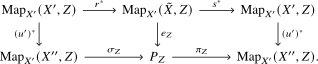 The horizontal composites are identities since \(rs=\id_{X'}\) and
\(\pi_Z\sigma_Z=\id\). Thus \((u')^*\) is a retract of the equivalence \(e_Z\), and is therefore
an equivalence. This proves that \(u'\) is terminal.