Construction 4.7.1 (Beck-Chevalley transformation). Let \(p\colon C \to S\) and \(q\colon D \to S\) be two cocartesian fibrations, and consider a commutative triangle
 By definition of cocartesian fibrations, the map \(\vec{\ev}^p_0\colon \Fun([1],C) \to C \vectimes{p} S\) admits a left adjoint section \(\lift^p_0\), and similarly \(\vec{\ev}^q_0\) admits a left adjoint section \(\lift^q_0\). In particular, we have identifications \(\vec{\ev}^p_0 \lift^p_0 = \id\) and \(\vec{\ev}^q_0 \lift^q_0 = \id\), and transformations \(\epsilon_p \colon \lift^p_0 \vec{\ev}^p_0 \to \id\) and \(\epsilon_q \colon \lift^q_0 \vec{\ev}^q_0 \to \id\). Observe that we have a commutative diagram
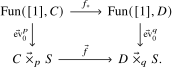 We now define the Beck-Chevalley transformation \(\BC_!\colon \lift^q_0\vec{f} \to f_*\lift^p_0\) as the following composite:
\[
\lift^q_0\vec{f} = \lift^q_0\vec{f}\vec{\ev}^p_0 \lift^p_0 = \lift^q_0 \vec{\ev}^q_0 f_* \lift^p_0 \xrightarrow{\epsilon_q} f_*\lift^p_0.
\]