Construction 9.6.1 (The Beck–Chevalley map under straightening). Consider a commutative square of small categories
 and a functor \(F\colon A \to \An\). This data determines the Beck–Chevalley map
\[
\BC_! \colon f'_!u^*(F) \to v^*f_!(F)
\]
in \(\Fun(B',\An)\). The Beck–Chevalley map is defined as the composite
\[
f'_!u^*(F) \xrightarrow{\eta} f'_!u^*f^*f_!(F) = f'_!{f'}^*v^*f_!(F) \xrightarrow{\varepsilon} v^*f_!(F),
\]
where \(\eta\colon \id_{\Fun(A,\An)} \to f^*f_!\) is the unit of \(f_! \dashv f^*\) and \(\varepsilon\colon f'_!{f'}^* \to \id_{\Fun(B',\An)}\) is the counit of \(f'_! \dashv {f'}^*\). Equivalently, \(\BC_!\) is adjoint to
\[
u^*(F) \xrightarrow{\eta} u^*f^*f_!F = {f'}^*v^*f_!(F).
\]
We next describe this map under straightening. Consider the pullback square
 where the right vertical map is the universal left fibration with small fibers. Choose a factorization of \(f \circ p\colon X \to B\) as
\[
X \xrightarrow{j} Y \xrightarrow{q} B,
\]
where \(j\) is initial and \(q\) is a left fibration. In particular, \(q\) is given via a pullback square
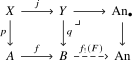 for some functor \(f_!(F)\). The commutative square on the left exhibits the unit \(F \to f^*f_!F\). Pulling back along \(v\) and \(u\), we obtain the commutative diagram
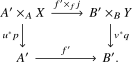 Write \(X':=A'\times_A X\). We may factor \(f' \times_f j\) as
\[
X' \xrightarrow{j'} Y' \xrightarrow{r} B' \times_B Y,
\]
where \(j'\) is initial and \(r\) is a left fibration. Then the composite
\[
q' := v^*q \circ r \colon Y' \to B'
\]
is again a left fibration. These factorizations fit into the commutative diagram
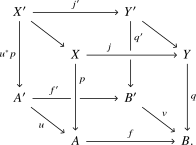 We have pullback squares
 and
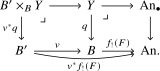 The map \(r\colon Y'\to B'\times_B Y\) over \(B'\) corresponds under directed
univalence to a natural transformation
\[
f'_!u^*(F)\to v^*f_!(F).
\]
Its adjunct along \(f'_!\dashv {f'}^*\) is represented by the composite
\(rj'\colon X'\to B'\times_B Y\). This composite is induced by \(j\colon X\to Y\),
which represents the unit \(F\to f^*f_!(F)\). Its adjunct is therefore the map
\[
u^*(F)\to u^*f^*f_!(F) = {f'}^*v^*f_!(F)
\]
that defines the Beck–Chevalley map. Hence \(r\) corresponds to
\(\BC_!\colon f'_!u^*(F) \to v^*f_!(F)\).