Proposition 9.1.8.
(1) Let \(u\colon C \to D\) be an initial (resp. terminal) functor. Then for every category \(E\), also the functor \(u \times \id_E \colon C \times E \to D \times E\) is initial (resp. terminal).
(2) Consider two functors \(u\colon C \to D\) and \(v \colon D \to E\) and assume that \(u\) is initial (resp. terminal). Then \(v\) is initial (resp. terminal) if and only if \(vu\) is initial (resp. terminal).
Proof
For (1), consider a functor \(f\colon D \times E \to S\) and a left (resp. right) fibration \(X \to S\). We want to show that the induced functor \[ - \circ (u \times \id_E)\colon \Map_S(D \times E, X) \to \Map_S(C \times E, X) \] is an equivalence. By uncurrying, the functor \(f\) corresponds to a functor \(\tilde{f} \colon D \to \Fun(E,S)\), and the above functor is equivalent to the functor \[ \Map_{\Fun(E,S)}(D, \Fun(E,X)) \xrightarrow{- \circ u} \Map_{\Fun(E,S)}(C, \Fun(E,X)). \] Since the functor \(\Fun(E,X) \to \Fun(E,S)\) is still a left (resp. right) fibration by Lemma 4.2.18, it follows from the assumption on \(u\) that this functor is an equivalence.
For (2), let \(X \to E\) be a left (resp. right) fibration, and consider the following commutative diagram:
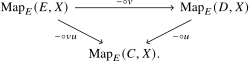 By assumption, the right diagonal map is an equivalence. It follows by 2-out-of-3 that the left diagonal map is an equivalence if and only if the top horizontal map is an equivalence.