Definition 4.2.7 (Category of lifts). Let \(f\colon A \to B\) be a functor, let \(\Gamma\) be a category, and consider a term
\(\Gamma\vdash(a,\beta):A \vectimes{f} B\), given by a term \(a\) of \(A\) and a morphism
\(\beta\colon f(a) \to b'\) in \(B\). We define the category \(\Lift^f_0(a,\beta)\) of
covariant lifts as the pullback
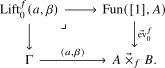 Its structural functor to \(\Gamma\) makes it a category in context \(\Gamma\). A term of
\(\Lift^f_0(a,\beta)\) is called a covariant lift of \(\beta\) starting in \(a\) and
consists of a morphism \(\alpha \colon a \to a'\) in \(A\) whose image under \(f\) is identified
with \(\beta\), i.e. there is an isomorphism between \(\beta\) and \(f(\alpha)\) as objects of
the relative slice \(B_{f(a)/}\).
Dually, for a term \(\Gamma\vdash(a',\beta):B \vectimes{f} A\), we define the category
\(\Lift^f_1(a',\beta)\) of contravariant lifts by the pullback
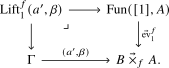 A term of \(\Lift^f_1(a',\beta)\) is called a contravariant lift of \(\beta\) ending in \(a'\) and consists of a morphism \(\alpha \colon a \to a'\) in \(A\) whose image under \(f\) is identified with \(\beta\), i.e. there is an isomorphism between \(\beta\) and \(f(\alpha)\) as objects of the relative slice \(B_{/f(a')}\).