Proposition 6.4.14. Let \(f\colon C \to D\) be any functor. The following conditions are equivalent:
(i) The functor \(f\) is conservative.
(ii) The commutative square
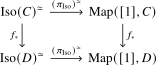 is a pullback square.
(iii) The commutative square
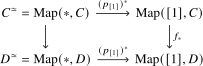 is a pullback square.
(iv) For any functor \(A\to D\) with \(A\) an anima, the pullback \(A\times_D C\) is an anima;
(v) The pullback \(D^{\simeq}\times_D C\) is an anima;
(vi) A given commutative square
 with \(X\) and \(Y\) animae is a pullback square whenever the associated square
 is a pullback square.
(vii) The square
 is a pullback square.
Proof
We first show the equivalence between (i) and (ii). Recall from Lemma 2.3.3 that the map \[ (\pi_{\Iso})^{\simeq}\colon \Iso(C)^{\simeq} \to \Map([1],C) \] is an embedding for every category \(C\). It thus follows from Lemma 1.6.26 that also the comparison map \[ \Iso(C)^{\simeq} \to \Iso(D)^{\simeq} \times_{\Map([1],D)} \Map([1],C) \] is an embedding. It thus follows from Lemma 1.6.24 that it is an equivalence if and only if it admits a section. Since this is a map of animae with proposition-valued fibers, the latter is equivalent to the existence of a lift for every object of the target, by applying this condition to the generic object in the context of that target anima. But since the objects in the target of this map are precisely those morphisms \(u\colon x \to y\) in \(C\) whose image in \(D\) is invertible, this lifting condition is precisely the condition on \(f\) that every such morphism \(u\) in fact comes from an isomorphism in \(C\), which is the definition of conservativity.
The equivalence between (ii) and (iii) is immediate from the equivalence \(C^{\simeq} \iso \Iso(C)^{\simeq}\) from the Rezk axiom, Axiom F. Conditions (iv) and (v) are equivalent: every map from an anima to \(D\) factors through \(D^{\simeq}\), and animae are closed under pullbacks. Under these conditions, \(Y\times_D C\) is an anima whenever \(Y\) is an anima. Since groupoid cores preserve pullbacks, there are equivalences \[ Y\times_D C\simeq (Y\times_D C)^{\simeq}\simeq Y\times_{D^{\simeq}}C^{\simeq}. \] This proves (vi). The implication (vi) \(\implies\) (vii) is clear. To see that (vii) implies (iii), we use that the functor \(\Map([1],-)\) preserves pullback squares, and apply the equivalence \(C^{\simeq} \iso \Map([1],C^{\simeq})\) coming from the fact that \(C^{\simeq}\) is an anima.
It thus remains to show that (iii) implies (v). Consider a pullback square
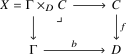 with \(\Gamma\) an anima. We must show that \(X\) is an anima as well. To this end, consider the following commutative diagram:
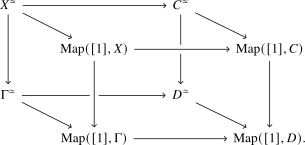 The back and front faces are pullback squares, and the right face is a pullback square by the hypothesis from (iii). We conclude from the pasting lemma of pullback squares that the left face
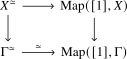 is a pullback square. Since the bottom map \(\Gamma^{\simeq} \to \Map([1],\Gamma)\) is an equivalence, it follows that also the top map \(X^{\simeq} \to \Map([1],X)\) is an equivalence, and thus we conclude from part (5) of Proposition 3.4.4 that \(X\) is an anima as desired.