Remark 4.8.2. Notice that the morphism \(u\colon x \to y\) is locally \(p\)-cocartesian if for every object \(z \in C_{p(y)}\) the functor \(v \mapsto vu\) given by composing with \(u\) induces an equivalence
\[
C_{p(y)}(y,z) \to C(x,z)_{p(u)},
\]
where \(C_{p(y)}\) is the fiber of \(p\) over \(p(y)\) and \(C(x,z)_{p(u)}\) is defined as the fiber
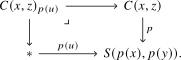 More informally, this says that for any morphism \(u'\colon x \to z\) equipped with an identification \(p(u') = p(u)\), there is a unique morphism \(v\colon y \to z\) in \(C_{p(y)}\) fitting in a commutative triangle
 in \(C\) which is sent under \(p\) to the degenerate commutative triangle on \(p(u)\) in \(S\).