Proposition 17.2.19. Let \(C\)be a small category with strictly \(\kappa\)-small colimits. Given a presheaf \[ F\colon C\catop\to\An\, , \] the following assertions are equivalent.
(i) The presheaf \(F\) belongs to \(\Ind_\kappa(C)\).
(ii) The functor \(F\colon C\catop\to\An\) commutes with \(K\catop\)-indexed limits for any strictly \(\kappa\)-small category \(K\).
(iii) The category \(C_{/F}\) has strictly \(\kappa\)-small colimits.
(iv) The category \(C_{/F}\) is \(\kappa\)-filtered.
Proof
Condition (iv) follows from condition (iii) by definition of subuniverses.
Since representable presheaves commute with limits,
Lemma 17.2.17 implies that
condition (ii) follows from condition (i).
Let \(F\) be a presheaf on \(C\) that commutes with \(K\catop\)-indexed limits for any
strictly \(\kappa\)-small category \(K\). We then have the following pullback square,
in which the lower horizontal map is the Yoneda embedding.
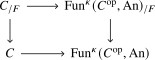 By virtue of Lemma 17.2.16, the Yoneda embedding above preserve
strictly \(\kappa\)-small colimits. The vertical functor on the right side
has a right adjoint (since \(\Fun^\kappa(C\catop,\An)\) is stable by pullbacks in \(\PSh(C)\))
hence commutes with all colimits that exist. More precisely this functor creates colimits:
since it is also conservative (being right fibration), any cocone in \(\Fun^\kappa(C\catop,\An)_{/F}\)
that become a colimit cocone in \(\Fun^\kappa(C\catop,\An)\) is a colimit cocone.
The dual version of Proposition 13.2.14 together
with Lemma 17.2.16 show that \(C_{/F}\) has strictly \(\kappa\)-small
colimits and that the projection to \(C\) preserves and detects them. In other words, condition (iii)
follows from condition (ii).
By virtue of Corollary 12.6.4, (i) follows from (iv).