Theorem 9.4.6. Let \(p\colon E \to S\) be a functor, and assume that \(p\) satisfies the property that for any pullback diagram of the form
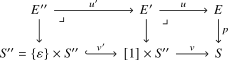 for \(\varepsilon = 1\) (resp. \(\varepsilon = 0\)) the base change \(u'\) is terminal (resp. initial). Then \(p\) is proper (resp. smooth).
Proof
We prove the statement for proper functors; the smooth case is dual. The strategy is to factor an arbitrary terminal functor into a fully faithful right adjoint, a localization, and a right fibration. The localization remains terminal after base change, the right-fibration factor is forced to be an equivalence, and the endpoint hypothesis handles the fully faithful factor.
Consider an arbitrary pullback diagram
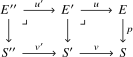 in which \(v'\) is terminal. We need to show that also \(u'\) is terminal. To this end, we factor \(v'\) as
\[
S'' = S''_0 \xrightarrow{j} S''_1 \xrightarrow{\lambda} S''_2 = \Pi_{\infty}(S''_1/S') \xrightarrow{q} S',
\]
where \(j\) is a fully faithful right adjoint, \(\lambda\) is a localization and remains so after pullback, and \(q\) is a right fibration. Consider now the following commutative triangle:
 The functor \(j\) is terminal because it is a right adjoint, and \(\lambda\) is terminal because it is a localization. Thus their composite \(S''\to S''_2\) is terminal. Since \(v'=q\lambda j\) is terminal, cancellation shows that \(q\) is terminal. As \(q\) is also a right fibration, it is an equivalence by Lemma 9.1.7. Now consider the following pullback diagram:
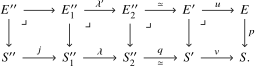 Since \(\lambda'\) is a localization, it is terminal by
Proposition 9.1.9. The functor \(E''\to E''_1\) is the pullback of
the fully faithful right adjoint \(j\). The relevant base change of \(p\) satisfies the
endpoint hypothesis because that hypothesis is stable under base change. Hence
Lemma 9.4.5 shows that
\(E''\to E''_1\) is terminal. The remaining map is an equivalence, so the composite
\(u'\colon E''\to E'\) is terminal.