Proposition 6.5.4. Let \(p\colon C \to S\) be a locally cocartesian fibration. The following conditions are equivalent:
(1) The functor \(p\) is a cocartesian fibration;
(2) Every locally \(p\)-cocartesian morphism of \(C\) is \(p\)-cocartesian;
(3) Locally \(p\)-cocartesian morphisms are closed under composition: if \(f\colon x \to y\) and \(g\colon y \to z\) are locally \(p\)-cocartesian morphisms in \(C\) then so is \(gf\colon x \to z\).
Proof
If \(p\) is a cocartesian fibration, then condition (2) holds: indeed, if \(f\colon x\to y\) is a locally \(p\)-cocartesian morphism, then there is a unique \(p\)-cocartesian lift \(g\colon x\to y'\) of \(p(f)\).
Since both \(f\) and \(g\) are locally \(p\)-cocartesian lifts of \(p(f)\) with the same source, there is
a unique isomorphism \(u\colon y'\to y\) in the fiber of \(p(y)\) such that \(f=ug\). In particular,
\(f\) is the composition of two \(p\)-cocartesian morphisms, hence is \(p\)-cocartesian as well.
Since \(p\)-cocartesian morphisms are stable under composition, it is clear that condition (3) follows from
condition (2). It remains to prove that condition (1) follows from condition (3).
Let us assume that condition (3) holds and that \(f\colon x\to y\) is a locally \(p\)-cocartesian
morphism. Definition 4.5.5 tells us that,
in order to prove that \(f\) is \(p\)-cocartesian, it suffices to prove that,
for any object \(z\) in \(C\),
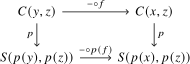 is a pullback square of animae. This means that we have to check that the map induced by this pullback square
\[
C(y,z)\to S(p(y),p(z))\times_{S(p(x),p(z))} C(x,z)
\]
is an equivalence. In other words, by virtue of Proposition 1.3.1, if we consider any morphism \(g\colon x\to z\) in \(C\) as well as a morphism \(v\colon p(y)\to p(z)\) in \(S\) such that
\(p(g)\) is the composition of \(v\) and \(p(f)\), we have to prove that there is a unique
morphism \(u\colon y\to z\) in \(C\) such that \(p(u)=v\) and such that \(g\) is the composition of \(u\) and \(f\).
We define \(u'\colon y\to z'\) as the unique locally \(p\)-cocartesian lift of \(v\) with source \(y\).
Since \(u'f\) is a locally \(p\)-cocartesian lift of \(vp(f)\), there is a unique
morphism \(h\colon z'\to z\) in the fiber over \(p(z)\) such that \(hu'f\) is identified with \(g\). Define \(u:=hu'\).
If we have another morphism of the form \(w\colon y\to z\) in \(C\) such that \(wf=g\),
and such that \(p(w)=v\), then we have a unique morphism \(k\colon z'\to z\) in the fiber over \(p(z)\)
such that \(ku'=w\). In particular, we must have
\[
h \, u'\, f=g \quad\text{and}\quad k\, u'\, f=g
\]
and the universal property of \(u'\, f\) as locally \(p\)-cocartesian lift of \(v\, p(f)\)
implies that \(k\) and \(h\) must agree as terms of \(C(z',z)\). Therefore, \(u=w\) must hold true. We have proved that the locally cocartesian lifts are cocartesian. The dual of Proposition 6.5.1 therefore shows that \(p\) is a cocartesian fibration.
From Section 6.5, Pointwise and fiberwise criteria for fibrations.