Corollary 2.2.8. For every category \(C\), the commutative squares
 are pullback squares.
Proof
We will prove the claim for the left square and leave the analogous proof of the right square to the reader. Note that this square can be written as the outer square in the following commutative diagram:
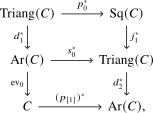 and so it will suffice that each of these two squares is a pullback square. The first one follows from applying the pasting law of pullback squares to the following commutative diagram:
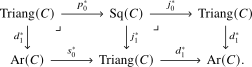 Here the outer square is evidently a pullback, and the right square is a pullback by the commutative square axiom, Axiom D. The second one similarly follows from applying the pasting law of pullback squares to the following commutative diagram:
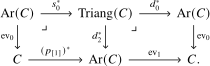 Here the outer rectangle is again evidently a pullback square, and the right square is a pullback square by the Segal axiom, Axiom E.