Construction 4.5.6. Let \(f\colon A\to B\) be a cocartesian fibration.
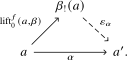
Since the functor \(\lift^f_0\) is a left adjoint section of \(\vec{\ev}^f_0\), it comes equipped with a natural transformation \(\epsilon\colon \lift^f_0 \circ \,\vec{\ev}^f_0 \to \id_{\Fun([1],A)}\). In particular, for a morphism \(\alpha\colon a \to a'\) in \(A\) with underlying morphism \(\beta := f(\alpha)\colon f(a) \to f(a')\) in \(B\), we obtain a morphism \(\epsilon_{\alpha}\colon \lift^f_0(a,\beta) \to \alpha\) in \(\Fun([1],A)\), corresponding to a commutative square in \(A\) of the form
 The image of this square under \(\vec{\ev}_0^f\) is identified with the identity of \((a,\beta)\) by the triangle identity of the adjunction. In particular, \(\epsilon_\alpha\) lies over \(\id_{f(a')}\). By Corollary 2.2.8, we may think of this square in \(A\) as a commutative triangle in \(A\) of the form