Proposition 15.2.12. A morphism of Segal animae \(f\colon X\to Y\) is an equivalence if and only if it is fully faithful and induces an equivalence \(f_0\colon X_0\iso Y_0\).
Proof
An equivalence is levelwise an equivalence, so the condition is necessary.
Conversely, if \(f\colon X\to Y\) is fully faithful and induces an equivalence
\(f_0\colon X_0\iso Y_0\), then it induces an equivalence
\[
f_1\colon X_1\iso Y_1
\]
as well: \(f_1\) is then a pullback of the equivalence \(f_0\times f_0\).
This implies right away that \(f\) induces an equivalence of the form
\[
\underset{\text{$n$ times}}{\underbrace{X_1\times_{X_0}\cdots\times_{X_0}X_1}}
\iso\underset{\text{$n$ times}}{\underbrace{Y_1\times_{Y_0}\cdots\times_{Y_0}Y_1}}\, .
\]
The commutative square
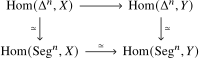 thus implies that \(f_n\colon X_n\iso Y_n\) is an equivalence for all \(n : \N\).