Theorem 4.6.3. For any category \(C\), the functor \(\ev_0\colon \Fun([1], C) \to C\) is a cartesian fibration. Dually, the functor \(\ev_1\colon \Fun([1],C) \to C\) is a cocartesian fibration.
Proof
We show the statement for \(\ev_0\) and leave the dual case of \(\ev_1\) to the reader. We need to show that the map
\[
\vec{\ev}_1^{\ev_0} \colon \Fun([1],\Fun([1],C)) \to C \vectimes{\ev_0} \Fun([1],C)
\]
admits a right adjoint section. We may identify the source of this map with \(\Fun([1] \times [1], C)\). The target sits by definition in a pullback square
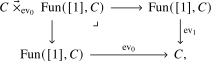 and thus we may identify it with \(\Fun(\Lambda^2_1, C)\). Unwinding definitions, we see that the map \(\vec{\ev}_1^{\ev_0}\) factors as
 where the second map is a trivial fibration by the Segal axiom. It will thus suffice to show that \(j_1^*\) admits a right adjoint section.
We claim that \(p_2^*\) is a right adjoint section of \(j_1^*\). Indeed, we have \(j_1^*p_2^* = (p_2j_1)^* = (\id)^* = \id\). The transformation \(h\colon 1 \to j_1p_2\) gives rise to a transformation \(h^*\colon 1 \to (j_1p_2)^* = p_2^*j_1^*\) via Construction 4.6.2. Furthermore, we have \[ j_1^*h^* = (hj_1)^* = \id_{j_1^*} \qquadtext{ and } h^*p_2^* = (p_2h)^* = \id_{p_2^*}. \] This finishes the proof.