Corollary 6.4.17. For every category \(C\), the functor \((\ev_0,\ev_1)\colon \Fun([1],C) \to C \times C\) is conservative.
Proof
We will check condition (iii) from Proposition 6.4.14. Under the currying-uncurrying equivalence from Lemma 1.7.12, this translates to showing that the square
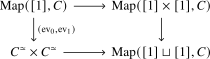 is a pullback square. For this, it will in turn suffice to express the category \([1]\) as a pushout of \([0] \sqcup [0]\) and \([1] \times [1]\) along \([1] \sqcup [1]\). For this, we consider the following commutative square:
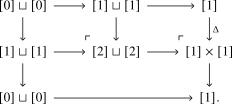 In this diagram, both of the top two squares are pushouts as a consequence of the Commutative Square Axiom, Axiom D, where for the top right square we use the dual of Lemma 1.6.13. Since the outer square is vertically degenerate and hence also a pushout square by the dual of Lemma 1.6.12, it follows from the pasting law for pushout squares that the bottom rectangle is a pushout square, as desired.