Proposition 6.5.12. Consider a commutative diagram
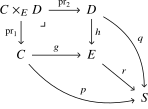 of categories, and assume that the functors \(p,q,r\) are cocartesian fibrations and \(g\) and \(h\) are cocartesian functors over \(S\).
(1) The induced functor \(C \times_E D \to S\) is a cocartesian fibration;
(2) The projection functors \(\pr_1\) and \(\pr_2\) are cocartesian functors over \(S\);
(3) For every other cocartesian fibration \(T \to S\) and cocartesian functors \(t_C\colon T \to C\) and \(t_D\colon T \to D\) over \(S\) equipped with an identification \(g t_C = h t_D\) over \(S\), the induced functor \((t_C,t_D)\colon T \to C \times_E D\) is a cocartesian functor over \(S\).
Proof
Write \(\pi\colon C\times_E D\to S\) for the induced functor. An object of the pullback consists of objects \(x\) of \(C\) and \(y\) of \(D\) together with a specified identification \(g(x) = h(y)\). Let \(w\colon s_0\to s_1\) be a morphism in \(S\), and choose \(p\)- and \(q\)-cocartesian lifts \[ u\colon x_0\to x_1 \qquadtext{and} \qquad v\colon y_0\to y_1 \] of \(w\). Since \(g\) and \(h\) are cocartesian functors, \(g(u)\) and \(h(v)\) are \(r\)-cocartesian. Their sources are identified by the pullback datum, so uniqueness of cocartesian lifts supplies a unique identification \(g(x_1) = h(y_1)\) compatible with \(g(u)\) and \(h(v)\). Hence \((u,v)\) defines a morphism in \(C\times_E D\).
We verify the local universal property of \((u,v)\). Consider a compatible pair of morphisms from \((x_0,y_0)\) to an object \((x',y')\) over \(s_1\) whose image under \(\pi\) is \(w\). The universal properties of \(u\) and \(v\) give unique vertical factorizations \(x_1\to x'\) and \(y_1\to y'\). Their images in \(E\) are compatible: after precomposition with the \(r\)-cocartesian morphisms \(g(u)\) and \(h(v)\), the required compatibility is exactly that of the original pair, and the universal property of these \(r\)-cocartesian morphisms detects the compatibility uniquely. Thus \((u,v)\) is locally \(\pi\)-cocartesian.
Now let \(a\) be any locally \(\pi\)-cocartesian lift of \(w\) with source \((x_0,y_0)\). Comparing \(a\) with the componentwise lift just constructed, uniqueness of locally \(\pi\)-cocartesian lifts gives an isomorphism between their targets in the fiber over \(s_1\). Hence the projections of \(a\) are \(p\)- and \(q\)-cocartesian. We have proved that the locally \(\pi\)-cocartesian morphisms are precisely the compatible pairs of \(p\)- and \(q\)-cocartesian morphisms. Such pairs are stable under composition, so Proposition 6.5.4 implies that \(\pi\) is a cocartesian fibration. The same characterization shows that both projections preserve cocartesian morphisms, and hence are cocartesian functors.
Finally, let \(T\to S\) and \((t_C,t_D)\) be as in (3). A cocartesian morphism of \(T\) is sent by \(t_C\) and \(t_D\) to a compatible pair of \(p\)- and \(q\)-cocartesian morphisms. By the characterization just proved, its image in \(C\times_E D\) is \(\pi\)-cocartesian. Hence \((t_C,t_D)\) is a cocartesian functor over \(S\).
From Section 6.5, Pointwise and fiberwise criteria for fibrations.