Proposition 6.5.13 (Fiberwise criterion for cocartesian fibrations). Let \(p\colon E\to S\) and \(q\colon D\to S\) be cocartesian fibrations, and let \(u\colon E\to D\) be a cocartesian functor over \(S\). Then \(u\) is a cocartesian fibration if and only if the following conditions hold:
(1) For every object \(s\) of \(S\), the induced functor \(u_s\colon E_s\to D_s\) is a cocartesian fibration.
(2) For every morphism \(v\colon s\to t\) in \(S\), the transport functor \(v_!^E\colon E_s\to E_t\) sends \(u_s\)-cocartesian morphisms to \(u_t\)-cocartesian morphisms.
Proof
Condition (1) is interpreted at the universal object in context \(S^{\simeq}\), and condition (2) at the universal morphism in context \(\Map([1],S)\), with the fiber categories obtained by substitution along its source and target. First observe that every \(p\)-cocartesian morphism is \(u\)-cocartesian: its image under \(u\) is \(q\)-cocartesian, so this follows by cancellation of pullback squares in Definition 4.5.5.
Suppose that \(u\) is a cocartesian fibration. Condition (1) follows by base change.
Moreover, a morphism in \(E_s\) is \(u_s\)-cocartesian if and only if its image in \(E\)
is \(u\)-cocartesian, by
Observation 4.8.6 and Proposition 6.5.4.
For such a morphism \(\alpha\colon x\to y\) and a morphism \(v\colon s\to t\),
naturality of the \(p\)-cocartesian lift gives a commutative square
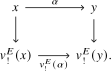 Both vertical morphisms and the upper horizontal morphism are \(u\)-cocartesian.
Composition and cancellation of cocartesian morphisms show that the lower horizontal
morphism is \(u\)-cocartesian as well. It is therefore \(u_t\)-cocartesian, proving (2).
Conversely, suppose that (1) and (2) hold. We first show that every
\(u_s\)-cocartesian morphism \(\alpha\colon x\to y\) in \(E_s\) is \(u\)-cocartesian
in \(E\). For an object \(z\) of \(E\), write \(t=p(z)\) and consider the square
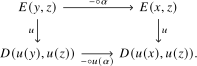 This is a square of animae over \(S(s,t)\). On its fiber over \(v\colon s\to t\),
the universal properties of cocartesian transport identify the upper row with
precomposition by \(v_!^E(\alpha)\) in \(E_t\), and the lower row with precomposition
by \(v_!^D(u_s(\alpha))\) in \(D_t\). Since \(u\) is cocartesian over \(S\), the
identification \(u_t v_!^E = v_!^D u_s\) identifies this fiber square with the
square expressing that \(v_!^E(\alpha)\) is \(u_t\)-cocartesian, and hence it is a pullback
by (2). The displayed square is therefore a pullback as well, since this can be
checked on fibers over the anima \(S(s,t)\) by
Lemma 6.1.12. Now
Definition 4.5.5 proves the claim.
Let \(\beta\colon u(e)\to d\) be a morphism in \(D\), and write \(v=q(\beta)\colon s\to t\). Choose a \(p\)-cocartesian lift \(\eta\colon e\to v_!^E(e)\). Its image under \(u\) is \(q\)-cocartesian, so \(\beta\) factors as \(\overline\beta\,u(\eta)\) for a morphism \(\overline\beta\colon u_t(v_!^E(e))\to d\) in \(D_t\). By (1), choose a \(u_t\)-cocartesian lift \(\lambda\colon v_!^E(e)\to e'\) of \(\overline\beta\). Both \(\eta\) and \(\lambda\) are \(u\)-cocartesian by the preceding arguments, and pasting their mapping-anima pullback squares shows that \(\lambda\eta\) is \(u\)-cocartesian. Moreover, it is a lift of \(\beta\) with source \(e\).
The dual of Proposition 6.5.1 now shows that \(u\) is a cocartesian fibration.
From Section 6.5, Pointwise and fiberwise criteria for fibrations.