Construction 5.3.2 (Generic fiber). Let \(p\colon X\to A\) be an absolute functor. Its generic fiber, denoted \(F_A(p)\), is the fiber of \(W_Ap\) at \(a_A\):
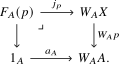 A functor over \(A\) induces a functor between generic fibers by the universal property of this pullback. The identification to \(A\) supplies the commutative square needed for this construction. Identifications between functors over \(A\) likewise induce identifications between the functors on generic fibers.
We can now relate a category to the generic fiber of its total category. For a category \(B\) in context \(A\), the identity \(W_A(\pr_1^B)\eta_B=a_Ap_B\) induces a functor \[ r_B\colon B\longrightarrow F_A(\pr_1^B). \] In the other direction, the dependent-sum axiom extends \(j_p\colon F_A(p)\to W_AX\) to an absolute functor \[ s_p\colon\Sigma_AF_A(p)\longrightarrow X. \] This functor lies over \(A\). Indeed, restricting \(p\circ s_p\) along the pair functor gives \(W_Ap\circ j_p=a_A\circ p_{F_A(p)}\), which is also the restriction of \(\pr_1^{F_A(p)}\). The uniqueness clause for dependent sums therefore gives an identification \(p\circ s_p=\pr_1^{F_A(p)}\).