Lemma 5.3.3 (Relative mapping animae for dependent sums). Let \(B\) be a category in context \(A\), and let \(p\colon\Sigma_AB\to Z\) and \(q\colon Y\to Z\) be absolute functors. Regard \(B\) as a category over \(W_AZ\) by the functor \(W_Ap\circ\eta_B\). Then restriction along \(\eta_B\) induces an equivalence \[ \Map_{/Z}((\Sigma_AB,p),(Y,q)) \iso\Pi_A\Map_{/W_AZ}((B,W_Ap\circ\eta_B),(W_AY,W_Aq)), \] where the relative mapping anima on the right is formed in context \(A\).
Proof
The restriction equivalences of Proposition 5.2.4 fit into the following square, whose vertical functors are induced by postcomposition with \(q\):
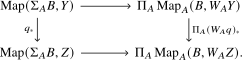 The square commutes by currying the identification
\[
W_A(qh)\circ\eta_B
= (W_Aq\circ W_Ah)\circ\eta_B
= W_Aq\circ(W_Ah\circ\eta_B)
\]
on the whole mapping anima of functors \(h\colon\Sigma_AB\to Y\). The lower horizontal functor sends \(p\) to the section represented by \(W_Ap\circ\eta_B\). Taking the fibers of the vertical functors at these points therefore gives an equivalence. The source is the displayed relative mapping anima. Since \(\Pi_A\) preserves pullbacks and terminal categories, the target is
\[
\Pi_A\Map_{/W_AZ}((B,W_Ap\circ\eta_B),(W_AY,W_Aq)).
\]
More explicitly, a point \((h,\alpha\colon qh=p)\) in the source is sent to the functor \(W_Ah\circ\eta_B\) equipped with the identification \[ W_Aq\circ(W_Ah\circ\eta_B) =W_A(qh)\circ\eta_B \xrightarrow{(W_A\alpha)\star\eta_B}W_Ap\circ\eta_B. \] Since we obtained this map by taking fibers, it also sends identifications between functors to identifications compatible with these triangles. Its inverse recovers both the functor and its commutative triangle.