Lemma 2.1.28. For categories \(C\) and \(D\), the maps \(C^{\simeq} \to (C \sqcup D)^{\simeq}\) and \(D^{\simeq} \to (C \sqcup D)^{\simeq}\) induce an equivalence \(C^{\simeq} \sqcup D^{\simeq} \iso (C \sqcup D)^{\simeq}\).
Proof
Let \(i_0\colon * \to * \sqcup *\) and \(i_1\colon * \to * \sqcup *\) denote the inclusions of the first and second point, respectively. By combining Lemma 1.6.4 and Axiom B.5', there are pullback squares
 It remains to show that the two maps \(i_0^{\simeq}\) and \(i_1^{\simeq}\) induce an equivalence
\[
q\colon (*)^{\simeq} \sqcup (*)^{\simeq} \longrightarrow (* \sqcup *)^{\simeq}.
\]
The defining identifications for groupoid-core functoriality give a commutative square
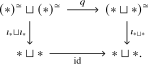 The left vertical functor is an equivalence by Proposition 1.4.15, and the right
vertical functor is an equivalence by
Proposition 1.4.15, since \(*\sqcup *\) is an anima. Hence \(q\) is an equivalence by
2-out-of-3. The two pullback squares above, descent for coproducts, and base change along \(q\)
now identify \(C^{\simeq}\sqcup D^{\simeq}\) with \((C\sqcup D)^{\simeq}\).