Proposition 6.4.10. Let \(f\colon C\to D\) be a functor and let \(s\colon D\to C\) be a left (resp. right) adjoint of \(f\). The following conditions are equivalent:
(i) The functor \(s\) is a left (resp. right) adjoint section of \(f\).
(ii) The functor \(s\) is fully faithful.
(iii) For every object \(y\) of \(D\), the unit map \(y \to f(s(y))\) (resp. the counit map \(f(s(y)) \to y\)) is an isomorphism.
Proof
We prove the case in which \(s\) is right adjoint to \(f\); the other case is dual. Let \(\eta\colon \id_C \to sf\) and \(\epsilon\colon fs \to \id_D\) denote the unit and counit. Conditions (i) and (iii) are equivalent by the objectwise criterion for natural isomorphisms, Proposition 3.4.6.
Given objects \(x\) and \(y\) of \(D\), consider the
counit map \(\epsilon_x\colon fsx \to x\). By the triangle identity, the composite
\[
sx \xrightarrow{\eta_{sx}} sfsx \xrightarrow{s\epsilon_x} sx
\]
is the identity and we may now consider the following commutative diagram:
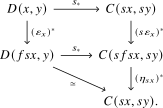 As discussed in the proof of Proposition 4.4.7, the diagonal composite
\[
D(fsx,y) \xrightarrow{s_*} C(sfsx,sy) \xrightarrow{\eta_{sx}^*} C(sx,sy)
\]
is precisely the adjunction equivalence. This shows that the map \((\epsilon_x)^*\)
is an equivalence for all \(x\) and \(y\) if and only if \(s_*\) is an equivalence for all \(x\) and \(y\).
The latter property expresses precisely the property for \(s\) to be fully faithful.
The first property expresses the invertibility of \(\epsilon_x\) for all \(x\)
(Exercise 2.6.2).
This shows that (ii) and (iii) are equivalent.