Proposition 9.1.11. Let \(v\colon D \to C\) be a left Bousfield localization with right adjoint section \(u\colon C \hookrightarrow D\). Then \(u\) is a terminal functor. Dually, a left adjoint section of \(v\) is an initial functor.
Proof
We prove the first case, and leave the second dual case to the reader. Consider a right fibration \(p\colon X \to D\). The unit transformation \(\eta \colon \id \to uv\) corresponds to a functor \(\eta\colon [1] \times D \to D\), allowing us to regard \([1] \times D\) as a category over \(D\). Consider now the following square:
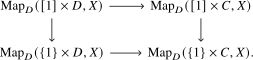 Since the inclusion \(\{1\} \hookrightarrow [1]\) is terminal by Example 9.1.10, so is \(\{1\} \times C \to [1] \times C\) by Proposition 9.1.8, and hence both vertical functors are equivalences. It follows that the square is a pullback square, i.e. we have an equivalence
\[
\Map_D([1] \times D, X) \iso \Map_D([1] \times C, X) \times_{\Map_D(\{1\} \times C, X)} \Map_D(\{1\} \times D, X).
\]
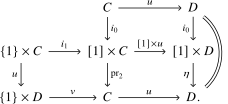
We will finish the proof by exhibiting the map \(- \circ u\colon \Map_D(D,X) \to \Map_D(C,X)\) as a retract of this equivalence, implying that it is itself an equivalence as desired. To this end, we consider the following diagram:
 The fact that all these maps are well-defined and that the two squares commute is a consequence of the following commutative diagram over \(D\):
 This finishes the proof.