Proposition 13.2.5 (Limits in cocartesian unstraightenings). Let \(A\) be a small anima and let \(p\colon E\to B\) be a small cocartesian fibration. Assume that \(B\) admits \(A\)-indexed limits and that the functor \(B\to\Cat\) classifying \(p\) preserves them. Then \(E\) admits \(A\)-indexed limits and \(p\) preserves them.
Proof
Write \(F\colon B\to\Cat\) for the functor classifying \(p\). We prove the following more precise assertion. Let \(\widetilde X\colon A\to E\) be a functor, write \(X:=p\widetilde X\), and choose a limit cone \[ \lambda\colon\const_b\longrightarrow X \] in \(B\). Write \(E_X:=A\times_B E\) for the pullback of \(p\) along \(X\). Cocartesian transport along \(\lambda\) defines a comparison functor \[ \kappa_\lambda\colon F(b)\longrightarrow\cocart_A(A,E_X). \] Concretely, \(\kappa_\lambda(x)\) is the cocartesian section whose value at \(a\in A\) is \((\lambda_a)_!x\); its structure morphisms are supplied by the functoriality of cocartesian transport and the naturality of \(\lambda\). If \(\kappa_\lambda\) is an equivalence and \(x\in F(b)\) corresponds to the section defined by \(\widetilde X\), then the resulting \(p\)-cocartesian cone \(\const_x\to\widetilde X\) is a limit cone in \(E\).
Indeed, every morphism of \(A\) is invertible, so every morphism in the image of \(\widetilde X\) is an isomorphism. Isomorphisms are \(p\)-cocartesian, and hence \(\widetilde X\) determines a cocartesian section of \(E_X\to A\). Applying an inverse of \(\kappa_\lambda\) to this section gives \(x\) and the stated \(p\)-cocartesian cone.
It remains to prove that this cone is a limit cone in the total category.
Let \(z\in F(c)\). Consider the commutative square
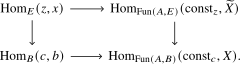 The lower horizontal map is an equivalence because \(\lambda\) is a limit
cone. We claim that the square is a pullback. Fix a morphism
\(f\colon c\to b\). The fiber of its left vertical map over \(f\) is
\[
\Hom_{F(b)}(f_!z,x).
\]
For every \(a\in A\), functoriality of cocartesian transport gives a canonical
isomorphism
\[
\kappa_\lambda(f_!z)(a)
=(\lambda_a)_!(f_!z)
= (\lambda_a f)_!z.
\]
Cocartesian factorization along the canonical cone from \(f_!z\) to
\(\kappa_\lambda(f_!z)\) identifies the fiber of the right vertical map over
\(\lambda f\) with the mapping anima, in the category of cocartesian sections
of \(E_X\to A\), from \(\kappa_\lambda(f_!z)\) to the section defined by
\(\widetilde X\).
Using the chosen identification of this section with
\(\kappa_\lambda(x)\), full faithfulness of \(\kappa_\lambda\) shows that the
induced map between the two fibers is an equivalence. Thus the square is a
pullback. Its upper horizontal map is therefore an equivalence, which is the
universal property of the asserted limit cone. This proves the more precise
assertion.
By Theorem 13.2.4, the target of \(\kappa_\lambda\) is the limit of \(F\circ X\), so preservation of \(\lambda\) says precisely that \(\kappa_\lambda\) is an equivalence. The preceding construction applies to every diagram in an arbitrary anima context. The pointwise criterion for indexed limits, dual to Proposition 7.2.2, therefore assembles the construction into a right adjoint to the constant-diagram functor. The image of the constructed cone under \(p\) is \(\lambda\), so \(p\) preserves these limits.