Proposition 14.1.3 (Products of localizations). Let \(C\) and \(C'\) be two categories, with wide subcategories \[ W\hookrightarrow C\quad\text{and} \quad W'\hookrightarrow C' \] respectively, and associated localization functors \[ \gamma\colon C\to L(C,W)\quad\text{and}\quad \gamma'\colon C'\to L(C',W')\, . \] Then the functor \[ \gamma\times\gamma'\colon C\times C'\to L(C,W)\times L(C',W') \] induces an equivalence \[ L(C\times C',W\times W')\iso L(C,W)\times L(C',W')\, . \]
Proof
Let \(\varphi\colon C\times C'\to D\) be any functor.
Given morphisms \(f\colon x\to y\) and \(f'\colon x'\to y'\) in \(C\) and \(C'\) respectively,
we have a canonical commutative square of the form below.
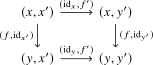 Since both \(W\) and \(W'\) are wide, all identities of \(C\) belong to \(W\) and all identities of \(C'\)
belong to \(W'\). Consequently, the property for the functor \(\varphi\) to send all morphisms in \(W\times W'\)
to isomorphisms is equivalent to the conjunction of the following two properties:
• For any morphism \(f\colon x\to y\) in \(W\) and any object \(x'\) of \(C'\), the morphism \(\varphi(f,\id_{x'})\) is an isomorphism in \(D\).
• For any morphism \(f'\colon x'\to y'\) in \(W'\) and any object \(x\) of \(C\), the morphism \(\varphi(\id_x,f')\) is an isomorphism in \(D\).
In other words, the currying equivalence \[ \Fun(C\times C',D)\iso\Fun(C,\Fun(C',D)) \] restricts to an equivalence \[ \Fun^{W\times W'}(C\times C',D)\iso\Fun^W(C,\Fun^{W'}(C',D)) \] functorially in \(D\). This implies that there is a canonical equivalence \[\Fun^{W\times W'}(C\times C',D)\iso\Fun(L(C,W),\Fun(L(C',W'),D))\, . \] Using the equivalence \[ \Fun(L(C,W)\times L(C',W'),D)\iso\Fun(L(C,W),\Fun(L(C',W'),D)) \] it follows that the functor \(\gamma\times\gamma'\) exhibits \(L(C,W)\times L(C',W')\) as a localization of \(C\times C'\) at \(W\times W'\).