Proposition 9.1.9. Let \(f\colon C \to D\) be a localization, so it factors as \(C \to C[W^{-1}] \iso D\) for some collection of morphisms \(W \hookrightarrow \Map([1],C)\). Then \(f\) is both initial and terminal.
Proof
Recall that \(\Map^W(C,T)\) denotes the full subanima of \(\Map(C,T)\) on the functors that send all morphisms in \(W\) to isomorphisms in \(T\). Consider a left (resp. right) fibration \(p\colon X \to D\). By Lemma 6.4.18, \(p\) is conservative. Hence a functor \(F\colon C \to X\) sends the morphisms in \(W\) to isomorphisms in \(X\) if and only if \(pF\colon C \to D\) sends them to isomorphisms in \(D\). It follows that the right square in the following diagram is a pullback:
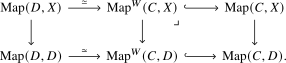 The left square is also a pullback square since both horizontal functors are equivalences. By passing to fibers over the identity \(\id_D\colon D \to D\), this shows that the induced functor
\[
\Map_D(D,X) \to \Map_D(C,X)
\]
is an equivalence, which is what we needed to show.