Proposition 1.4.5. For categories \(C,D,E\), the projections induce an equivalence \[ (\pr_{1,*},\pr_{2,*})\colon \Map(E,C\times D)\iso\Map(E,C)\times\Map(E,D). \]
Proof
We define a functor \[ h\colon\Map(E,C)\times\Map(E,D)\longrightarrow\Map(E,C\times D) \] by pairing the two functors \[ \begin{aligned} (\Map(E,C)\times\Map(E,D))\times E &\xrightarrow{\pr_1\times\id_E}\Map(E,C)\times E \xrightarrow{\ev_{\Map}}C,\\ (\Map(E,C)\times\Map(E,D))\times E &\xrightarrow{\pr_2\times\id_E}\Map(E,D)\times E \xrightarrow{\ev_{\Map}}D, \end{aligned} \] and currying the resulting functor to \(C\times D\). This is possible since \(\Map(E,C)\times\Map(E,D)\) is an anima.
We start by showing that the composite \((\pr_{1,*},\pr_{2,*})\circ h\) is identified with the identity. It will suffice to show this after projecting to both factors, and by symmetry we may just do this for \(\Map(E,C)\). In other words, we must show that \(\pr_{1,*}\circ h\) is identified with \(\pr_1\). It will in turn suffice to show this after uncurrying. But the uncurrying of both functors is identified with \[ (\Map(E,C)\times\Map(E,D))\times E \xrightarrow{\pr_1\times\id_E}\Map(E,C)\times E \xrightarrow{\ev_{\Map}}C, \] by the construction of \(h\) and the definition of postcomposition.
We will now show that also the composite
\(h\circ(\pr_{1,*},\pr_{2,*})\) is identified with the identity.
Uncurrying reduces this to comparing two functors
\[
\Map(E,C\times D)\times E\longrightarrow C\times D.
\]
It suffices to compare their two projections, and again we may just
consider the \(C\)-component. The projection of the uncurried identity
is \(\pr_1\circ\ev_{\Map}\); the projection of the other functor is
\(\ev_{\Map}\circ(\pr_{1,*}\times\id_E)\). These are identified by the
defining commutative square for postcomposition:
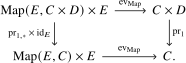 The product axiom and then the mapping-anima axiom give the desired
identification.