Proposition 4.6.5. For a functor \(f\colon C \to D\), the projection \(\ev_1\colon C \vectimes{f} D \to D\) is a cocartesian fibration, while the projection \(\ev_0\colon D \vectimes{f} C \to D\) is a cartesian fibration.
Proof
By symmetry, it suffices to prove the claim for \(\ev_1\colon C \vectimes{f} D \to D\). We thus need to show that the map \[ \vec{\ev}^{\ev_1}_0\colon \Fun([1],C \vectimes{f} D) \to (C \vectimes{f} D) \vectimes{\ev_1} D \] admits a left adjoint section. The proof is analogous to the proof of Theorem 4.6.3; to make the proof more readable we will explain what happens on objects and leave it to the reader to write a formal proof.
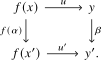
First observe that terms of the category \(\Fun([1],C \vectimes{f} D)\) are pairs \((\alpha, \sigma)\) where \(\alpha\colon x \to x'\) is a morphism in \(C\), and \(\sigma\) is a commutative square in \(D\) of the form
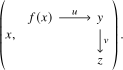
 On the other hand, terms of \((C \vectimes{f} D) \vectimes{\pi} D\) are of the form \((x,f(x) \xrightarrow{u} y \xrightarrow{v} z)\), which we might alternatively display as
 The map \(\vec{\ev}^{\ev_1}_0\) is then given by the assignment
 A left adjoint section is then given by the assignment
 The precise definition of this functor and the fact that it is a left adjoint section proceed just like the (dual version of the) proof of Theorem 4.6.3, using the functors \(j_0\colon \Delta^2 \to [1] \times [1]\) and \(p_0\colon [1] \times [1] \to \Delta^2\).