Lemma 9.6.5. Let \(f\colon A \to B\) be a proper functor between small categories. Consider an absolute object \(b\) of \(B\) and let \(A_b\) denote the fiber of \(f\) over \(b\). Then for any functor \(F\colon A \to \An\), there is a canonical isomorphism \[ \colim_{A_b} i^*F \iso b^*f_!(F) = f_!(F)(b) \] of animae, where \(i\colon A_b \to A\) denotes the inclusion of the fiber.
Proof
We will again translate this to a statement about left fibrations. Consider the left fibration \(p\colon X \to A\) associated to \(F\):
 Consider now the following pullback diagram:
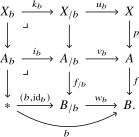 Since \(w_b\) is a right fibration, it is in particular smooth, hence by smooth base change (Theorem 9.6.2) we see that the canonical map
\[
\BC_!\colon (f_{/b})_!v_b^*(F) \iso w_b^*f_!(F)
\]
is an isomorphism. Passing to colimits over \(B_{/b}\), we obtain an equivalence
\[
\colim_{A_{/b}} v_b^*(F) \simeq \colim_{B_{/b}} (f_{/b})_!v_b^*(F) \simeq \colim_{B_{/b}} w_b^*f_!(F).
\]
Now consider the following commutative diagram:
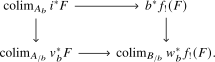 The square commutes by functoriality of Beck–Chevalley maps under pasting:
the bottom horizontal map is the mate obtained from the smooth base-change
isomorphism above, and its restrictions along the two terminal inclusions are
precisely the two vertical maps and the canonical top comparison map.
Since the inclusion \((b,\id_b)\colon * \to B_{/b}\) is terminal, the right vertical map is an equivalence by Proposition 9.6.3. But also \(i_b\) is terminal, since it is a base change of \((b,\id_b)\colon * \to B_{/b}\) along the proper functor \(f_{/b}\), hence also the left vertical map is an equivalence. By 2-out-of-3 it follows that also the top map is an equivalence, finishing the proof.