Theorem 13.4.5 (Quillen’s Theorem B). Let \(u\colon A \to B\) be a functor between small categories. The following conditions are equivalent.
(i) For any morphism \(\beta\colon b \to b'\) in \(B\), the induced functor \[ \beta_!\colon A_{/b} \to A_{/b'} \] induces an equivalence \(\Pi_{\infty}(A_{/b}) \iso \Pi_{\infty}(A_{/b'})\).
(ii) For any object \(b\) of \(B\), the square
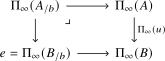 is a pullback square in \(\An\).
(iii) Any pullback square of the form
 in which \(g\) is a right fibration
induces a pullback square
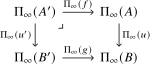 in \(\An\).
(iv) Any pullback square of the form
in which \(g\) is a smooth functor induces a pullback square
in \(\An\).
There is a dual set of equivalent conditions obtained by simultaneously replacing relative slices \(A_{/b}\) and \(B_{/b}\) by relative coslices \(A_{b/}\) and \(B_{b/}\), replacing \(\beta_!\) by \(\beta^*\), replacing right fibrations by left fibrations, and replacing smooth functors by proper functors.
Proof
We prove the displayed formulation in terms of slices, right fibrations, and smooth functors. The implications are organized as \[ (iii)\Rightarrow(ii)\Rightarrow(i)\Rightarrow(ii)\Rightarrow(iii), \qquad (iii)\Longleftrightarrow(iv). \] The dual formulation follows by applying this result to \(u\catop\) and using Corollary 12.4.6.
Condition (ii) follows from condition (iii) since the canonical projection
\(B_{/b}\to B\) is a right fibration. Similarly, assuming condition (ii),
any morphism \(\beta\colon b\to b'\) induces a pullback square of the form
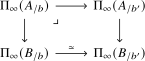 in which the lower horizontal map is an endomorphism of the terminal object, so that
the upper horizontal map must be invertible.
It remains to prove that condition (i) implies condition (ii).
Let \(e\) be the terminal object of \(\An\). We will also write \(e\) for the constant
presheaf with value \(e\).
We have \(A = A_{/e}\) and \(A_{/b} = A \times_B B_{/b} = A_{/u^*(\Hom_B(-,b))}\), where
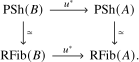 Since \(\Pi_{\infty}\) commutes with colimits (being a left adjoint),
Lemma 13.3.4 implies that
\[
X \mapsto \Pi_{\infty}(A_{/X})
\]
preserves colimits. But the functor \(u^*\) also has a left adjoint and thus commutes with
colimits. This proves that
the assignment \(Y \mapsto \Pi_{\infty}(A_{/u^*Y})\) commutes with colimits. Since we have
\[
\colim_B h_B = e\qquad\text{and}\qquad u^*(e)=e\, ,
\]
by Theorem 12.6.3,
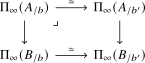
we see that \(\colim_{b : B} \Pi_{\infty}(A_{/b}) \simeq \Pi_{\infty}(A_{/e}) \simeq \Pi_{\infty}(A)\). Since for every morphism \(\beta\colon b \to b'\) we have a pullback square
 it follows from Lemma 13.4.4 that the commutative square
induced by passing to colimits is a pullback square, as desired.
We will finally prove that condition (ii) implies condition (iii).
For any object \(b'\) of \(B'\), if we put \(b=g(b')\), the induced functor
\[
B'_{/b'}\to B_{/b}
\]
is an equivalence over \(B\) (it is a terminal functor between right fibrations).
The horizontal arrows in the commutative square
 are equivalences, and we thus obtain from condition (ii) a pullback square of the form
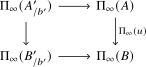 for each object \(b'\) in \(B'\). The transition maps in the two \(B'\)-indexed
diagrams are equivalences, and hence their naturality squares are pullbacks.
Applying Lemma 13.4.4 and using
\[
\colim_{b':B'}\Pi_{\infty}(A'_{/b'})\iso\Pi_{\infty}(A')
\quad\text{and}\quad
\colim_{b':B'}\Pi_{\infty}(B'_{/b'})\iso\Pi_{\infty}(B')
\]
shows that condition (iii) follows from condition (ii).
Since every right fibration is smooth, condition (iv) implies condition (iii). For the converse, given a pullback square of the form
in which \(g\) is a smooth functor, we choose a factorization of \(g\) into \(g=q\circ j\)
with a terminal functor \(j\colon B'\to B''\) and a right fibration \(q\colon B''\to B\).
We define \(A''=B''\times_BA\). The functor \(j\) induces a functor \(i\colon A'\to A''\)
that is terminal (we see this by applying Corollary 12.4.7
in the case where \(\varphi\) is the identity). If \(p\colon A''\to A\) denotes the base change of \(q\),
and \(u''\colon A''\to B''\) the canonical projection,
we obtain a commutative diagram of the form
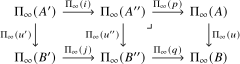 in which the two horizontal maps of the square at the left hand side are equivalences.
Therefore,
since the square at the right hand side is a pullback square, so is the composite.