Theorem 11.2.13. Let \(u\colon A \to B\) be a functor. Assume there exists a cover \(i\colon X \to B^{\simeq}\) such that for every object \(x\) of \(X\), the relative slice category \(A_{/i(x)} = A \times_B B_{/i(x)}\) admits a terminal object. Then \(u\) admits a right adjoint.
Proof
For any anima \(\Gamma\), we can consider the situation in context \(\Gamma\): we may ask whether the resulting functor \(u_{\Gamma} \colon A_{\Gamma} \to B_{\Gamma}\) admits a right adjoint in context \(\Gamma\). If this holds for \(\Gamma = B^{\simeq}\), it also holds in the absolute context.
If \(Y\) is an anima equipped with a map \(b\colon Y \to B^{\simeq}\), then in context \(B^{\simeq}\) this looks like
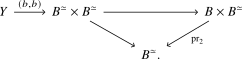 So we may express that \(A_{/b}\) has a terminal object for every object \(b\) of \(B\) as a proposition \(P\) in context \(B^{\simeq}\). The existence of a terminal object is then expressed as the assertion that this proposition \(P\)
is equivalent to the terminal anima in context \(B^\simeq\). To prove such an equivalence,
by virtue of Proposition 11.2.6,
it suffices to check that the structural map \(P\to B^\simeq\) becomes an equivalence after
pulling back along the cover \(i\colon X\to B^\simeq\).
The hypothesis says precisely that this pullback is terminal. We conclude
that all relative slices \(A_{/b}\) admit terminal objects in context
\(B^\simeq\), and hence that \(u\) admits a right adjoint by
Theorem 6.2.1.
From Section 11.2, Covers.