Proposition 14.3.5 (Recognition of a calculus of fractions). Let \(p\colon W(x)\to C_{/x}\) be a putative right calculus of fractions at an object \(x\) of \(C\). A necessary and sufficient condition for this putative right calculus of fractions at \(x\) to be a right calculus of fractions at \(x\) is that the canonical map \[ \underset{w : W(x)\catop}{\colim}\Hom_C(z_w\catop,y)\longrightarrow \Hom_{L(C)}(x,y) \] is invertible for all \(y\). Furthermore, when this condition holds, the resulting isomorphism is uniquely characterized by its functoriality in \(y\) and by the property that it sends the identity of \(x\), viewed as a term of the colimit through \(i_x\), to the identity morphism of \(\gamma(x)\) in \(L(C)\).
Proof
We identify the condition that \(H_x\) descend through \(\gamma\) with invertibility of its localization unit. We then compare this unit with the canonical fraction map and finally use the Yoneda lemma to prove the asserted uniqueness.
We have an adjunction of the form \[ \gamma_!\colon\Fun(C,\An)\rightleftarrows\Fun(L(C),\An)\colon\gamma^* \] and the right adjoint \(\gamma^*\) is fully faithful, with essential image those functors from \(C\) to \(\An\) sending every morphism in \(W\) to an isomorphism. The functor \(\gamma_!\) preserves small colimits because it is a left adjoint, while \(\gamma^*\) preserves them because colimits in functor categories are computed pointwise, by Lemma 7.3.1. Hence the unit \[ \eta_F\colon F\to\gamma^*\gamma_!(F) \] is compatible with small colimits in \(F\). Since \(\gamma^*\) is fully faithful, \(\eta_F\) is an isomorphism if and only if \(F\) sends every morphism in \(W\) to an isomorphism. For \(F=\Hom_C(x,-)\), the unit map coincides with the map \[ \eta\colon\Hom_C(x,-)\to\Hom_{L(C)}(\gamma(x),\gamma(-)) \] induced by \(\gamma\). Set \[ H_x:=\underset{w : W(x)\catop}{\colim}\Hom_C(z_w\catop,-). \] Applying the naturality of Yoneda from Proposition 12.3.18 to \(\gamma\catop\), the unit at \(H_x\) identifies with the colimit of the units for the representable functors \(\Hom_C(z_w,-)\): \[ \eta'\colon H_x\longrightarrow \underset{w : W(x)\catop}{\colim}\Hom_{L(C)}(\gamma\catop(z_w\catop),\gamma(-)) \] is an isomorphism if and only if \(H_x\) sends every morphism in \(W\) to an isomorphism. This is precisely the condition that \(p\) be a right calculus of fractions.
For every \(y : C\), consider the commutative diagram
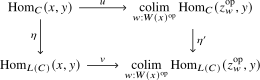 Here the vertical maps are unit maps, while \(u\) and \(v\) are the maps from
Construction 14.3.3. The map \(v\) is an
isomorphism, and the canonical map is \(v^{-1}\eta'\). This proves the first
assertion and also shows that the canonical isomorphism sends the
distinguished identity term to the identity of \(\gamma(x)\) in \(L(C)\).
Finally, when \(p\) is a right calculus of fractions, both \(H_x\) and \(\Hom_{L(C)}(x,\gamma(-))\) descend uniquely to functors on \(L(C)\). Any two isomorphisms with the stated property differ by an automorphism of the representable functor \(\Hom_{L(C)}(x,-)\) that fixes the identity of \(x\). The Yoneda lemma for \(L(C)\catop\) implies that this automorphism is the identity, proving uniqueness.